Showing posts with label depression. Show all posts

Friday, 5 May 2017

What Wrong With Having Problems?


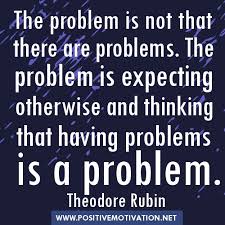
"The problem is not there are problems. The problem is expecting otherwise and thinking that having problems is a problem." Theodore Rubin

A problem is not a problem until you call it a problem. Before that, it is an occurrence or simply something that happened. Expecting all occurrences to be void of breakdowns/problems is a formula for disappointment.

From another perspective, think of the times you felt you were in the zone. It could have been an athletic event or a business transaction. When you were in the zone, problems had little or no effect on you. You may have looked at them as a slight bump in the road and you proceeded to solve the problem with little or no effort. And then you continued on with your goal.

Later, when you were asked how did you solve the challenge so effortlessly, you may have responded that it was like an outer body experience. And it would have been hard for you to explain. When we are in the zone, problems rarely show up as insurmountable. That's the example of when life is good. So why do people have problems with problems?

Perhaps the real reason we have problems with problems is because we secretly expect them. When they show up, we say, 'I knew something would go wrong'. It's like we programmed ourselves for the disappointment.

When they happen, we are upset because life seems to be filled with one problem after another. And all we want is a smooth harmonious life with no problems. It's like we are waiting for the day that we believe we deserve - a life with no problems. But, as usual, we know the next breakdown is just around the corner.

In fact, we spend time dreaming about the day we meet the right person and find the right job that will give us eternal peace and harmony. While at the same time, our environment has trained us to never get too happy because the next problem is around the corner.

Nevertheless, we have all had the experience of being in the zone. If you focus on doing something well, you will find it much easier to get into the zone. In that space, you will find problems rarely seem to be a problem.


Wednesday, 26 April 2017

Overcoming Envy: What Envy Teaches You


Envy gets a bad rap. The ancient Greek philosopher Antisthenes described it as corrosive ("As iron is eaten away by rust, so the envious are consumed by their own passion.") Envy is established as one of the seven deadly sins - hardly a list of traits that we celebrate.

Yet we all feel it. Envy is part of the human experience. Instead of judging envy as wrong or bad, is there something we can do with it?

Envy begins with social comparison. Social comparison is a psychological process where we try to determine our own personal worth by comparing ourselves to others. So often, the result is we see ourselves as not measuring up.

Research shows that this process of comparison happens continually and automatically, underneath our awareness. And it sets us up for an inevitable deflation of confidence and self-esteem, what I call "compare and despair".

What we may not recognize is how shame is at the root of this despair. Shame is a deeply felt sense that we are defective, inadequate or not good enough. Shame is fuel for envy. When we look at somebody else and feel envy, it's not just that someone has acquired or achieved something, but that we believe we are unable to acquire or achieve something like it.

Well, that stinks.

But, wait. What if there is a positive side to envy?

Because, when we are in despair, we are missing something important: envy is information. Envy is giving you clues about what you desire. Look at your envy to start following the clues. Ask yourself:


Who do I envy?
What is it about them that generates envy?Since social comparison happens so quickly, envy can be vague, like a cloud around the person to whom you are comparing yourself. You feel it but you may not know why.


When you identify the source, envy becomes specific. You can examine it more closely.

Now this is where it gets really good, because envy gives you the opportunity to challenge the assumptions that underlie it.

Consider the source of your envy. Ask yourself:


Is it something I really want?
Do I think I can have it? Or can I attain something similar or create a similar feeling for myself?Let's say, for example, that you envy your neighbors who own a boat. They take their boat out on the water every weekend and it pains you each time they head out on Saturday morning.


Is it the boat you really want (with all of its associated responsibilities like dock fees and storage, maintenance and repairs, insurance and fuel, equipment and supplies)?

Or is it a sense of freedom? wealth? escape? (or something else?) that the boat represents for you?

There is no right or wrong answer - it's about understanding what you really want. Because when you know what you want you can begin to deliberately bring it into your life.

This is how you transform envy, by utilizing it as a tool to help you understand:


What you really want, what you value, what success looks like for you
How you can generate that for yourselfWhen you are clear about what's most important and what it looks like in your life, you can start building it for yourself.


What other people have and do becomes so much less significant. Comparisons won't matter. And you'll be happier when you are focused on your life, rather than on the lives of others.


Source: 

Friday, 31 March 2017

Finding Inner Peace


Finding inner peace is the path of letting go, even though, the path could be as hard or simple as a person makes the journey of self acceptance.

"He who lives in harmony with himself lives in harmony with the universe" ~ Marcus Aurelius

There are always many ups and downs in every one's life. Sometimes we get stuck in a world of confusion, wondering how we find a constant inner peace in our hearts and lives, when there is always something wrong in our lives or the lives of those we love.

What happens when we start to feel down or stressed?

First of all some kind of negative thought comes into our mind that gets us discouraged and anxious. The next thing that happens, is that we start believing in that thought. And feeding it with more arguments, which in turn gets us into a deeper state of confusion and sadness. Next thing we know, we find ourselves, there in that deep mud hole. We look around and all is doom and gloom.

What can we do so that this does not even happen?

1 - Accept what is: Life is unpredictable. Nothing is permanent, everything changes; and of course, a lot of things can happen that will transform who we are and have an impact on our life. The problem is that we need to be prepared to truly accept whatever comes and embrace it. This is what I have noticed with so many people, in that we focus and linger on things which we have no control over. Why worry about something that all the worrying in the world will not change? Why care about what other people think of us when we're not even sure what it is they are actually thinking? Yes, acceptance is a choice-a hard one most definitely, but a choice nonetheless. By practicing acceptance we learn to live in this changing world, where we never know what's going to happen next. Acceptance is like protecting ourselves with our own shields." You have to accept whatever comes and the only important thing is that you meet it with courage and with the best that you have to give" ~ Eleanor Roosevelt

2 - Meditate: Meditation makes us mentally strong, and emotionally resilient. It reduces the tendency to react, increases the tendency to respond and is an effective way to de-stress our minds. If you are not meditating yet then, you are missing out on a very important activity that can change your life. When you have a lot on your mind and you feel like your thoughts are driving you crazy, meditation can help you find peace, calmness and more self acceptance. Meditation helps turning one's life into a more beautiful, harmonious and happy one. When mind, body and spirit are in harmony, then everything seems right with the world."Through concentration and meditation you become the boss of your mind, and gain the ability to tell it when to be active and when to stay silent" ~ Remez Sasson

3 - Spend time in nature: Nature calls you back to reality. We can't stop it from raining. We can't delay the setting sun. We can't set the temperature to a comfortable degree. When we are climbing a mountain, our muscles are going to burn. But with this surrender comes such relief! We awake from a dream and realize how little control we really have. We remember that hardship and lack of control are part of life, and accepting this reality makes it not only bearable, but possible to feel the joy of being alive. By being in nature we feel comfortable in our own skin, we experience our own quiet peace and strength, we sense the inner us that is the true us. The mask we present to the outer world is irrelevant for a time, and put in its proper place. Nature helps us to connect with this powerful, loving presence, whether we call it GOD, Earth Mother, the Great Mystery or any another name. Nature brings us closer to GOD, our own spirit and helps us to live lives of meaning and joy. "The best remedy for those who are afraid, lonely or unhappy is to go outside, somewhere where they can be quite alone with the heavens, nature and God. Because only then does one feel that all is as it should be and that God wishes to see people happy, amidst the simple beauty of nature. As longs as this exists, and it certainly always will, I know that then there will always be comfort for every sorrow, whatever the circumstances may be. And I firmly believe that nature brings solace in all troubles." ~ Anne Frank

4 - Learn the power of a smile: A smile is a powerful key to living happy from the inside out. The simple act of smiling sends a message to your brain that you're happy. And when you're happy, your body pumps out all kinds of feel-good endorphins. Smiles are powerful and contagious. Don't hesitate to smile warmly at friends, family, colleagues and even strangers. Never stop smiling! God smiles on us each and every day. His love has no depth, his mercy no end. His arms are open wide, just step into them. "Smile and the world will smile with you."

5 - Choose to help others: Care for others genuinely around you. What you put out, you really get back in life. Being caring allows us to have empathy for others and to live a life based on affection, love, and compassion for the people around us. When we make a positive impact in someone else's life, we also make a positive impact in our own lives. Any act of kindness and goodwill eases our way towards inner peace. When we start helping others, we stop thinking about our so-called problems and then we realize that our life is not so bad after all. Do something that's greater than you - something that helps someone else to be happy or to suffer less. "No one is useless in this world who lightens the burdens of another." ~ Charles Dickens

6 - Never lose hope: Never give up. Never lose hope. Always have faith, it allows you to cope better during the trying times. Having hope is a personal decision, a bold conviction-a choice, and with hope we always have a path towards peace. Having hope is an active, decisive mindset etched into every single moment. No matter the haze and fog that clouds our vision, hope's laser cuts through, and never losing sight of her shimmering stars. Hope is something we can never afford to lose Who we really are is based on values we choose to live by, such as believing in the possible, believing in the goodness of others, and believing in the power of love and hope. When we decide to passionately pursue our greatest purpose, then we become the hope in our lives and manifest her greatest dreams, because we refuse to consider any other possibility. As Henry James put it, "Be not afraid of life. Believe that life is worth living, and your belief will help create the fact."

7 - Embrace your beliefs: I am not here to favour any belief system over another, but whatever it is that you are believing in, hold it closely in your arms, accept it willingly and enthusiastically, as by being within your faith, peace will find its way into your heart. We all might have different opinion in regards to our belief systems, but one thing that we all have to acknowledge is that without a healthy and solid belief system, we won't be able to find a fair conscience which could show us the way towards peace and wisdom. "Faith is universal. Our specific methods for understanding it are arbitrary. In the end we are all just searching for truth, that which is greater than ourselves." ~ Dan Brown

8 - Live in the present moment: When we live fully in the present moment, our awareness becomes completely centred on the here and now. We won't worry about the future or thinking about the past. How often have you been worrying about things that have yet to come, or how often have you been beating yourself for mistakes that you've made, no matter how much time has passed? Too much time, I believe. Not only living in present moment has a significant effect on our emotional health, but also it has a great impact on our physical wellbeing. By living in present moment we live in acceptance; we accept life the way it is, not the way we wish, it should have been. And when we live in acceptance, we realize that everything is complete as it is. We can forgive ourselves for the mistakes we've made, and we can have peace in our hearts knowing that everything that should happen will. "If you worry about what might be, and wonder what might have been, you will ignore what is."

Finding inner peace is not a simple or short path, but it is a process that we can all learn. It is a journey which needs to be appreciated every step of the way. We have to be willing to let go and step outside the box that we have accepted ourselves to be put into, in the first place and start from scratch. We have to be ready getting to know ourselves all over again and be willing to make mistakes. And most importantly, we have to realize that only we have control over our emotional responses and reactions and they can be changed for the better. And finally when serenity and unconditional love fill our hearts, we will accept that we cannot go back, and will not give up what we have now found, that peace that we seem to have been searching for our whole lives. "Remember, the entrance door to the sanctuary is inside you." ~ Rumi


Inner peace resides within us at all times. It has been said the only thing that prevents the human mind from finding peace, is the human mind itself. "Nothing can bring you peace but yourself."


Plus-You Can Now Join Our FREE Mastering Success Facebook Community at www.masteringsuccess.group


Friday, 24 March 2017

Top Tips To Help You Stop Procrastinating


Here are my top tips to help you stop procrastinating:

Tip #1 Small Chunks

Just divide all the things you have to do into small chunks. It doesn't matter if you only have a little time and think it's not worth starting anything now. Honestly IT IS! If I'd have done lots of little bits daily in my business (when I thought I didn't have enough time) I'd be much further ahead than I am now!

There are many times I can think of now where I wasted 30 mins at least thinking about pointless things when I could have listened to half an hour of audio training, written a blog, filmed a video or done some internet research etc! So YES these snippets of time are so valuable for doing SOMETHING! Perhaps you're a mum like me who is always busy, looking after children, doing housework, working part time and also building a business from home. You may also have pets and other commitments which keep you constantly tied up! So therefore any snippet of time is valuable! So use them wisely!

Tip #2 Brainstorm & Write A Weekly Plan

Firstly do a brainstorm or brain splurge on paper where you literally write out all of the things you need to do. That will instantly make you feel better! I used to find that I had so much to do I was scared to think about everything so it was easier to block it out and just do nothing! Very productive!!

So if you just get every single thing out on paper that you need to do, then prioritise each task and make a weekly plan. Then you can see clearly what you need to do and when. Give realistic time scales as otherwise you'll put too much in one day, not get it done and feel bad! So write down what you think you'll achieve per day. Even if you don't get around to doing everything that day, just be gentle with yourself knowing that you've been productive and forward those things on to the following day.

Tip #3 Change your environment

If you're finding that you're not getting much inspiration to do any work then try changing your location/environment. You may normally work in a particular room but perhaps you're not feeling motivated. Whether you change rooms or even go out and find a coffee shop or go for a walk, changing your environment can really help you get back on track and help stop you procrastinating.

Tip #4 Listen to Music

Try listening to music, something that gets you really revved up and in the mood for working. Some people have running music to help them run faster, such as 'eye of the tiger'. I love a song by Enigma and even though it's not a fast song, I feel energised when I listen to it and it makes me want to get on and work my business. It also makes me feel happy and empowered. So try it for yourself and have fun choosing a song or songs to give you momentum!

Tip #5 Have a buddy

Either have one person, like a buddy or tell various friends and family what you're doing. Then you're holding yourself accountable for getting things done. If someone is expecting to receive a blog or report etc from you at a certain time or day then you're more likely to get it done on time rather than if you're just going to put it out there for anyone to see. If you're advertising something or are broadcasting material to nobody in particular then it's easy to procrastinate and let other more pressing things come first. So always believe there is someone waiting for you to deliver.

Tip #6 Just Do It!

Often we want things to be done perfectly and if they're not, we don't finish what we're doing, and therefore end up procrastinating! You may have to be a bit harsh with yourself, like a personal trainer can be, and just get on with it! Rather than making excuses and trying to make something so perfect that you end up procrastinating, just take control and TAKE ACTION! I promise you will feel so much better afterwards!

Working on my business from home has helped me learn a lot about myself and how easily I can procrastinate! But the reason WHY I'm working for myself from home is so important that it makes me have lots of 'Get Up & Go' and want to work hard! My WHY is my children who I want to spend as much time as possible with. And I want to give them the best life possible.

I wish you luck in your journey to stop procrastinating!


Plus-You Can Now Join Our FREE Mastering Success Facebook Community at www.masteringsuccess.group


Friday, 20 January 2017

5 Barriers That You Need to Cross to Achieve Success in 2017


It is a fact that success is achieved with a lot of hard work, struggle and persistence. However, one important factor that is usually ignored is mental strength. Some people are generally good when it comes to emotional stability or mental strength, however, others can work on it to make it better.

Mental and emotional strength can be developed with proper focus on it. However, to work on the development of emotional strength, it is important to analyze how you are spending your time. This will help you explore things that you need to quit doing and things that you need to work on.
Here are 5 barriers that you put into your own path:


1. Jealousy

When an individual decides to analyze and focus on other people’s blessings, this is where jealousy acts as a barrier to an individual’s own success. If you want to achieve success and mental peace, then it is very important to focus on things that you possess rather than things you don’t own. Moreover, somebody else’s luck cannot take anything away from you. Jealousy is an illusion and a barrier to success.


“Jealousy is the tribute mediocrity pays to genius.” – Fulton J. Sheen

2. Seeking perfectionism

It is observed that individuals delay things as they seek perfectionism. It is important to understand that perfectionism is actually underestimating yourself that you are not good enough. Perfectionism acts as a barrier to success. It leads an individual to depression and anxiety. It is important to overcome this barrier in order to gain success in 2017.

3. Comparing yourself to others


A true waste of time, effort and resources is comparing yourself to others. Successful people would never do it as they know that they are one of a kind. So if you really want to compare anything, it must be what you have achieved and what you are willing to achieve. Overcome this obstacle to achieve success in 2017.

4. Blaming others


It is a common attribute where an individual takes all the credit for the achievements and success. However, when things don’t work out then it gets easier for an individual to blame others. Blaming others for your failures is actually the biggest obstacle to success. You need to stop blaming others and starting focusing on solving the problems if you are really looking forward to achieve success in 2017.


“Your life is the fruit of your own doing. You have no one to blame but yourself.” – Joseph Campbell

5. Doubting yourself

Commonly, people doubt themselves on various occasions or instances. Where there is a doubt, there is no way. Hence, whenever a doubt comes in your mind, then it is time to remember all the things you have achieved. To overcome doubting yourself, it is important to remember the distance you have covered to be where you are today. Stop doubting yourself because it holds you back from moving forward.

Crossing these 5 barriers will help you gain mental and emotional strength. With enhanced and improved mental strength, you are going to be more powerful at work. This will definitely help you to overcome a lot of your weaknesses. In fact, it can be all that you require to achieve success in 2017.

Tuesday, 27 December 2016

Don't Let Life Happen to You


Don't Let Life Happen To You

It is not death that a man should fear, but he should fear never beginning to live. - Marcus Aurelius (121-80 AD, Roman Emperor, Philosopher)

It's hard to believe that we are nearing the end of another year. As I write this, snow is falling in Colorado, the makings of a fantastic Thanksgiving dinner are in the kitchen, and our newspapers are filled with holiday ads. The end of the year always tends to be a time of reflection as we look back on the accomplishments of the past year and look forward to a new year. It's also a time to reflect on our lives and ensure that we are living the life we want.

It's easy to look at ones life and be content with where you are. You have a good job, a spouse or significant other, children, a nice car, and all of the trappings of success. Clearly you are well on your way to success. But the real question is, are you happy with what you are doing?

No, this is not an article about the spiritual side of your life. Normally these articles focus all of the attention on management and leadership concepts that you can use to shape your career, improve your performance, and move up the ladder of success. But as we enter a new year it is important to take a step back and make sure that the path you are on is the right path for you.

You see life has a way of just happening to people. Your first job tends to be the job that you were first offered, in an industry that may or may not really interest you, doing what you may or may not have a real talent in. Your career then tends to grow from there. You get promoted or change companies, but tend to stay with what you are familiar with and what you have done in the past. Months turn into years and at some point in time you find that you are on a career path that you never really intended to be on at all. It may be a great, wonderful career path doing all of the things that are important to you, or it may be a path where you have had some successes, but don't find inspiring.

In short, your life has been on autopilot. That is when you know that life has happened to you.

You didn't plan to be where you are. And while you are not unhappy with where you are, you are not happy with it either. It does not speak to your inner being.

The purpose of life is to live a life of purpose. - Richard Leider

As you sit down in the coming weeks to plan your new years resolutions, take a few extra minutes to think about where you are in your life and where you are in your career. If you have not made a life plan in the past, start one now. Identify your core values. Identify what is important to you in life and in your career. Figure out were you want to be in 10 years and make sure your current path will take you there.

Your life is a fairy tale, with the journey unscripted. Take control of your life and write your own script. Understand your desires and passions and build a plan for your life that will be a source of happiness and pride. It may be in management and leadership. It may be in the arts. But whatever it is, make sure that you control your life and that your life does not just happen to you.


Thursday, 24 November 2016

10 Habits That Lower Self-Esteem and Cause Depression


When our self-esteem is low, which is typical of codependency, we're at greater risk for depression. Codependency is learned, and so are self-esteem and the beliefs and habits that cause both low self-esteem and codependency. Self-esteem is what we think about ourselves. It includes positive and negative self-evaluations. Good self-esteem is a realistic, positive self-concept. It reflects self-respect and implies a feeling of worth that's not determined by comparison to, or approval from, others. Self-acceptance (which some writers include as part of self-esteem) is even deeper. It's a feeling of being good enough, neither perfect, nor inadequate. We feel we have worth and are lovable, not merely because of beauty, talent, achievement, intelligence, status, or popularity. It's a sense of inner contentment.

We each have intrinsic value, not based on how we perform or what we do or give. Just as every baby and breed of animal are unique and worthy of love, so are we. Unfortunately, as codependents, many of us grew up in families where love was nonexistent, conditional, or had to be earned. We believed that we had to earn or win the love of a parent. As a result, we're afraid to be authentic for fear we may be disliked. We may pursue people who cannot love and reject those who love us. We "over-do" or "over-give" in relationships and at work, and end up feeling resentful, used, or exploited.

Habits that Damage Self-Esteem

If you conclude that self-esteem is essential to enjoying your life and enjoying enduring, healthy relationships, you're right! The following bad habits, typical of codependents, can make you feel insecure, ashamed, anxious, sad, and hopeless:


Negatively compare yourself to others
Find fault with yourself
Tyrannize yourself with "Should's"
Project self-criticism onto others and imagine they're judging you
Don't try new things to avoid failing
Procrastinate
Doubt your instincts and decisions
Ignore your needs and wants
Don't set boundaries and allow abuse, criticism, or exploitation
Refuse to forgive yourself


When we compare ourselves to someone else, whether favorably or unfavorably, we are measuring ourselves by an external standard. Feeling "better than" someone is really a means to compensate for underlying shame and low self-esteem. The lift we get is false. It would be more helpful to wonder why we need to compare ourselves to someone else. When we compare ourselves negatively, it's self-shaming. We feel inferior, lose confidence, and like ourselves less. It depresses our mood and discourages us.

An active "inner critic" besieges us with what we should and should not do and second-guesses what we've already done. Habitual fault-finding can cause us to assume others see us as we see ourselves. In this way, we project our critic onto others and anticipate and feel the effects of criticism or judgment that we imagine, even when none occurs.

Lowered self-confidence causes us to fear making mistakes, looking foolish, or failing. Our self-esteem is always on the line, so it's safer not to try anything new to avoid appearing incompetent or not succeeding. This is another reason we procrastinate tasks or experiences that are new or challenging. At the same time, we nag and criticize ourselves for failure to accomplish our goals. Rather than take a chance, we make ourselves wrong for not trying, which ensures "failure" and low self-esteem.

Accommodating others from an early age leaves us unsure of our values and beliefs and encourages reliance on others. Decision-making becomes difficult, even paralyzing. Low self-esteem and shame heighten our fear of making mistakes, leading to self-doubt, insecurity, and indecision. Instead, we procrastinate or look to others for validation, opinions, and answers, which further undermines our self-trust and self-esteem.

Accommodating others also alienates us from our needs and wants. By not acknowledging, expressing, and meeting our needs and wants, we're admitting to ourselves and others that they're not important; ergo, that we're not important. On the other hand, taking responsibility to meet our needs and/or ask for them (such as asking for a raise) builds self-esteem. When we don't, we feel helpless and a victim of circumstances and other people.

Not feeling worthy of love and respect - which we deny to ourselves - makes us vulnerable to abuse and exploitation. We don't feel worthy of being treated well, and deny, excuse, or rationalize being abused or disrespected. Dependent upon others' approval, we're afraid to set boundaries lest we alienate those we love or need. We're quick to blame ourselves and readily accept blame from others, because we're guilt-ridden due to shame. Although we forgive the mistakes of others, especially if we receive an apology, we're not as kind to ourselves. Apologies to ourselves don't count. In fact, we can punish ourselves or hold a grudge against ourselves for years over past mistakes.

Treatment for Low Self-Esteem and Depression 
Fortunately, we can grow our self-esteem and increase our capacity for self-fulfillment. It will enhance our creativity, ambition, physical and emotional health, loving relationships, and resilience in the face of adversity. It is the key to success.


Monday, 21 November 2016

7 Things Emotionally Intelligent People Don’t Do

The restaurant manager who speaks with poise and grace to the patron complaining loudly about the wait service. The levelheaded friend you call in your greatest times of need. The compassionate but composed rescue worker who aids victims after a natural catastrophe. The partner who angers rarely, forgives easily, and assumes accountability for their actions. The successful CEO who balances her profession, her family responsibilities, and her personal hobbies with equal measures of calm and confidence.


What do these people have in common?

In two words: Emotional Intelligence. A relatively new trend in the realm of pop culture and psychology today, Emotional Intelligence — or EQ — has existed since the beginning of time. According to Psychology Today, the preeminent site for mental health education and information, Emotional Intelligence is defined as an aptitude for identifying and managing emotions, and the emotions of others. It consists of three primary skills: the ability to analyse interior emotions and the feelings of those around them, the capacity to apply emotions to tasks, and the facility to take control of emotions — whether it’s managing their own before they veer out of control, or having the strength and capability to make another person smile, settle down, or handle a situation appropriately.

Those with high Emotional “IQs” have been proven to enjoy more prosperity in life. Whether they’re in a social or professional environment, they thrive. Studies demonstrate they have fewer mental health issues, including depression and anxiety. Their personal lives aren’t train wrecks, precisely because they’re lived from the point of thoughtful — and meaningful — decisions. They outperform others, excel at their jobs, are happy in their relationships, and consistently work towards attaining positive results in all aspects of life. So, the question is, what don’t they do?

Here are 7 things emotionally intelligent people, as a rule, avoid:


1. They don’t get caught up in other people’s drama.

One of the hallmarks of Emotional Intelligence is empathy, and those with high EQs extend it to everyone they cross. But there’s an enormous difference between displaying empathy towards a friend or loved one and allowing another person’s rage or misery to incense, dominate, or merely influence one’s well-being. Think of the histrionic behaviour of your co-worker who is “distraught” not because she’s going through a break-up but because her friend is. Or that cousin of yours who, instead of focusing on her individual personal crises, purposefully seeks out people who are distressed so that her problems disappear via distraction — a habit so ingrained she can’t seem to address her the complications in her own life.

Emotionally intelligent people, on the other hand, listen carefully, provide gentle, loving, but authoritative advice, and offer assistance. But they don’t permit others’ lives and reactions to rule their own.

2. They don’t complain.

Whining and grumbling implies two things — one, that we are victims, and two, there are no solutions to our problems. Rarely does an emotionally intelligent person feel victimised, and even more infrequently does an emotionally intelligent person feel that a solution is beyond their grasp. Instead of looking for someone or something to blame, they immediately think of how to constructively address the dilemma. They also know that their complaints influence the emotional responses of those around them, and instead search for ways to bemoan the dissolution of a relationship or a disappointment with a friend in private, effective ways — whether it’s taking a yoga class, meditating alone at a park, or simply getting their feelings out on the page.

3. They don’t always say yes — to others and themselves.


Like empathy, self-control and conviction are sure signs of an emotionally solid person. Emotionally intelligent people are well-aware that a second glass of wine will lead to negative consequences the next morning, just as they know that an invitation to go on a spontaneous weekend rendezvous will detract them from fulfilling their preexisting commitments. They are definitive about their decisions, rather than saying “I don’t know, maybe?” or “Perhaps I’ll skip the gym today,” which invites doubt — and with that, heightened anxiety, even depression.

The more often emotionally intelligent people exercise their right to say no, and the more frequently they rely on their willpower, the freer they are to concentrate on their ambitions and overall well-being.

4. They don’t gossip.


Emotionally acute people sidestep gossip as determinedly as they skirt drama. To involve themselves in scandalous talk, they know, is to shame another for a supposed error — and an emotionally intelligent person understands that all humans are equally deserving, and that what others might perceive as a mistake is an opportunity for improvement.

5. They don’t count on others for happiness or confidence.


Emotionally intelligent people are self-sufficient in all manners of life, including their contentment and peace of mind. They have learned that to bank on someone else making them feel joyful or worthy is to put themselves at risk for disappointment and hopelessness. Rather, they take their emotions in their own hands and find hobbies that delight them, strive for achievements that will lead to a sense of self-worth, and search within for love and acceptance.


6. They don’t engage in negative self-talk.

While few of us are entirely immune to thinking (or saying) pessimistic statements that begin with “I” (“I’m unattractive,” “I should have done better,” “I’m pathetic”), emotionally intelligent have the ability to curb cynical thoughts before they fall down the proverbial rabbit hole. Instead, they rely on facts to come to conclusions. For some, it’s a mere glance at their experience and accomplishments outlined on their CVs; for others, it’s the appearance of a clean and organised house, or an internal analysis of what they’ve done right.

After all, emotionally intelligent people acknowledge that negative thoughts are just that — thoughts — just as they recognise that the derogatory interior voices they hear are theirs to turn down, tune out, or silence completely.

7. They don’t dwell on the past.

People who exist more in their past than in their present are susceptible to a barrage of mental and spiritual grievances, from regret and nostalgia to agitation and trepidation. Emotionally intelligent people honour their pasts — the people they have loved, the mistakes they have made, the opportunities they’ve eschewed — but are mindful of the importance of living squarely in the here and now.

By learning from the past (instead of dwelling on it), the emotionally intelligent have the power to inform their present — without diminishing their ability to advance or harness three of the most vital emotions of all: Self-satisfaction, gratitude, and hope.

Sunday, 6 November 2016

How to Stop Isolating Yourself From Other People


For the first fifteen years of my life, I had no problems in my social life.

I was never very outgoing, but I always had friends around and felt confident in my social group. I never felt alone or incapable of interacting with others. I took my social prowess for granted; I didn’t know it was possible to lose the ease with which I connected with others.

Unfortunately, things took a very unexpected turn a few months ago. I lost two friendships in my life and took the blow very hard. As a result of feeling friendless due to unfortunate circumstances, I took the blame onto myself and started to see myself as an unlovable, unworthy person who didn’t have friends through a fault of my own.

Soon after losing my friends, I started avoiding social interaction altogether. I sat alone at lunch with my computer, pretending to do homework to avoid having to find a new group of kids to sit with. I no longer looked for social opportunities, but still felt surprised when I wasn’t invited to hang out with people, which only exacerbated the problem.

More and more, I started losing motivation and enjoyment in things related to my social and academic life. In short, I became depressed, and effectively isolated myself from everyone around me.


How to Stop Isolating Yourself From Other People

Isolation is a vicious cycle: we isolate ourselves because we don’t want to be hurt by others who might find us unlovable, but we are hurt even more when we find ourselves alone.

Shutting people out isn’t only a mental decision; our actions, body language, and tone of voice reflect our attitude to others. We are left alone, to our constant relief and sorrow: we aren’t being hurt, but we aren’t being loved or accepted either.

We soon learn that being alone is worse than interacting with others, even when there is a risk of being hurt or abandoned.

As social animals, we can’t live our lives in shadow, hiding from interaction.Loneliness is unsustainable and destructive. I learned this after about a month of isolating myself.

Recognizing that isolation is unhealthy is important, but it certainly doesn’t win the battle against depression on its own. The real struggle in fighting depression and isolation is figuring out how to combat it.

This, of course, is easier said than done- once you’ve isolated yourself, you’ve dug a hole, and getting back out is much harder than getting into it.

Here are a few ways in which I overcame my tendency to push others away, and how you too can stop isolating yourself from other people.


1. Identify the root cause of your isolation and determine why you view yourself as unworthy/incapable of interaction.
What is it about being social that scares you?

Did you lose a friend or get in a traumatic argument that made you believe you will only be hurt or abandoned if you get close to people? Consider the thoughts that run through your head as you interact with someone.


Do you tell yourself that you are unlovable? Do you feel that you will bore, upset, or annoy the other person? Do you convince yourself that you will be hurt or abandoned because you always are or now deserve it?

When I pushed others away, it was because I constantly told myself that no one would like me.

I was convinced that I would be abandoned by anyone I tried to talk to because no one would want to hold a conversation with me. It was frankly ridiculous; in the past, I had been well-liked and approached for advice and light conversation by many people.

It took a long time, but I finally gained the awareness of these thought patterns and was able to shut them down. I addressed each thought and learned to dismiss them as they entered my head as false.

This is not a change that can happen overnight, but simply becoming aware of each thought can make the difference between healing and a further spiral into depression.


2. Try to reconnect with an old friend or someone you haven’t spoken to since before you began to shut others out.

Once you identify the cause of your isolation and address it, you can reconnect with people again.

I’m a rather reserved person by nature, and meeting new people is a stressful activity for me.

I wanted to talk to people who weren’t aware of my depressed attitude during my depression, but forming entirely new friendships was out of the question in my emotional state.

Instead, I approached people who I’d talked to often in the past, and didn’t feel stressed saying hello to.

At the same time, these people were close to me long enough ago that they weren’t aware of my emotional state and didn’t try to leave me alone because I’d given them signals.

As a high school-er, I picked a few kids from my classes the previous year. You can pick old coworkers, neighbors, or even college friends to reconnect with. Even if the process is digital, it’s a great first step in learning how to reopen yourself to relationships and interactions in a safe, non-stressful environment.

It may even be better if the person you choose lives far away- you don’t have to worry about being quiet or unapproachable, because if you are, you don’t have to see that person on a daily basis.


3. Talk to a trusted person about your isolation.


This step was extremely difficult for me, because I thought of my depression as shameful and a place of weakness. I thought that being honest about my problem was the surest way for me to be abandoned.

Eventually my one remaining friend confronted me about my sadness and antisocial behavior, and I told her how I had been feeling. I explained how losing my other friends had affected me and how I began thinking poorly of myself.

I told her that I knew it was stupid and ridiculous, but it was hard to change the way I perceived interactions and myself.

My friend was gentle with me, but told me that I really was delusional and my belief that I was unlovable was completely a figment of my imagination. Hearing this from someone close to me was perhaps the most powerful thing in helping me heal.

Find someone you trust and feel close to and let them know how you’re feeling.

If they truly do care about you (and someone does, I promise!) they will tell you that you are wrong about yourself. It’s important to tell yourself that you’re being ridiculous, but hearing it from someone else can have a much greater and more healing effect.

After all, if another person is convincing you that you are worthy of their attention, they must be telling the truth to be talking to you at all.

Once again, learning to reconnect with people after depression and antisocial behavior isn’t easy. It takes time, tears, and a lot of self-reflection. The process may seem tedious, but there is no short cut to healing for any illness, especially mental ones.

Keep your head up, trust yourself to have positive relationships, and remember: if you are human, you deserve love.

This is a fact. Things will get better before you know it.

Are you trying to stop isolating yourself from others? Has this article helped you?

Tuesday, 18 October 2016

6 Practical Ways To Stamp Out Negative Thoughts and Be More Positive


Thoughts are powerful things. They can literally empower you with confidence and motivation, or drain your energy and rob you of your get up and go. Clearly, thinking positive thoughts and maintaining a positive mindset is crucial for self-growth, but it isn't always that easy, right?

Admittedly, our thoughts are one of the hardest things to control, but there are a few painless strategies you can put to use right away to get negative thoughts under-control.

#1 Cultivate Mindfulness

Mindfulness simply means to live in the moment - the here and now. When you think about it, the present moment is the only moment that matters. The past is the past and the future has yet to happen. I think Eckhart Tolle summed it up best with, "Realize deeply that the present moment is all you have. Make the NOW the primary focus of your life."

#2 Stop Labelling Yourself

Negative thoughts like "I'm not good enough," "I could never achieve that," or "why does my life suck," are self sabotaging thoughts that feed your emotions and lower your self-esteem. From now on, listen out for that nagging voice in your mind, and pinch yourself when you do catch yourself labelling yourself or putting yourself down.

#3 You Gotta Roll With It

The famous band Oasis hit the nail on the head when they sung "you gotta roll with it." Of course, life is a roller coaster with many ups and downs. And you will experience rough patches where your will is going to be tested. But challenge yourself to look for the positive in everything and remind yourself that there's always a silver lining in the clouds.

#4 Selective Ignorance

External influences such as media and other people can have a significant impact on your own mental attitude. Choose to empower yourself with feedback and solicitations that are positive. Watching inspirational seminars, reading positive quotes, and listening to comedians are a few simple ways to empower your mind with positivity. Likewise, surround yourself with positive people and steer clear of those who drain your positive energy.

#5 Keep Your Mind Busy

If your mind is burdened with negative thoughts then get stuck into something to take your mind off it. Find productive activities that not only occupy the mind but leave you feeling positive and good, even if it's just a few house chores, anything that keeps your mind positively occupied is an effective tool for stamping out negative thoughts fast.

#6 Practice Meditation Daily

My favorite past time. Meditating truly is a powerful tool that can help you block out negative thoughts, feelings and emotions. Through daily meditation, you will learn to cultivate mindfulness and you will gain more control over your thoughts. Try it for 30 days. Just set aside 10 minutes a day for the next thirty days to work on finding your inner-zen.

The Bottom Line

There you have it, six practical tips to stamp out negative thoughts and cultivate a positive attitude. Puts these tips to use today and you will soon have those negative thoughts under-control.


Source:

Saturday, 1 October 2016

8 Keys To A More Positive Attitude


How often have you heard some discussion about the need for possessing a quality, positive attitude? While this topic is perhaps one of the most exhausted and discussed, it only proceeds to have a positive personal impact, when we are able to overcome our personal demons in such a way, as to proactively and consistently do something about it. Have you ever been objectively introspective enough to take a real look inside, and see if your positive rhetoric matches your perceptions and actions? Despite all your best intentions, do you ever notice (or does someone else remind you) that you are viewing or perceiving things in a negative manner, and either your responses, reactions, or actions indicate that behavior? Despite the challenges, here are 8 Keys for approaching our everyday lives in a more positive manner.


1. You have to really want to be positive: Frankly, being negative, for many, is what comes naturally. One will rarely move ahead positively until, and unless, he makes a personal decision to be as positive as he can be, and do something to achieve or accomplish that result.

2. Positive self-talk: What message are you giving to yourself? Are you telling yourself that you can, or not? The adage tells us that one can either think that they can or can't, and either way they'll be correct, directly addresses how our mind produces a self-fulfilling prophesy, either for the better, or worse.

3. Using affirmations: Have you created your own, personal affirmation list? These must be approximately ten areas you really wish to address, and must be stated in positive, present terms. This means, for example, if you wish to lose weight, avoid saying something like, I'm going to lose weight, and rather say, I feel healthy, happy and fit, and like seeing how I look in the mirror. This may sound simplistic, but the impact has the potential to be absolutely life-changing.

4. Take a deep breath - take a step away: Try to not get dragged down by the negativity or conflicts of others. Avoid the tendency to immediately respond, etc., but rather, it is often better for you to just calm down, clear your mind, and take control of your personal will.

5. Prepare and plan: The better you prepare and plan, the easier it is to feel good about your decisions, and to proceed proactively.

6. Make yourself more qualified, knowledgeable, etc.: It's often true that quality knowledge is indeed power!

7. Trust your judgment: When you follow a quality procedure, and have committed to training and learning, you will become more experienced and expert, and repeated expertise enhances your wisdom.

8. Transform worrying (negative!) to proactivity: When we use our energies towards worry, little positive is achieved. Rather than see and perceive problems, view obstacles as challenges, transform them to opportunities, and make the best choices, and proceed ahead.

Negativity nearly always is a weakening behavior. These 8 Keys should help you proceed with a more positive attitude.


Source: 

Tuesday, 13 September 2016

People Pleasing: Why Do Some People Experience Anxiety When They Don't Please Others?


People Pleasing: Why Do Some People Experience Anxiety When They Don't Please Others?

It has been said that one's life can be an expression of their own needs or it can be an expression of other people's needs. When it comes to the former, one is pleasing themselves; whereas when it comes to the latter, they are pleasing others.

True Fulfillment

In order for one to live a fulfilling existence, it is clearly going to be important for them to take care of their own needs. Now, this doesn't mean that one will therefore overlook other people's needs.

There is a strong chance that they will meet other people's needs through putting their own needs first. For example, one could create their own business and even though this will allow them to full their needs, it will also enable them assist others.


Win-Win

As a result of this, it will be possible for one to fulfil their own needs and to fulfil other people's needs. The alternative would be for one to be there for others, but to overlook what is taking place within them.

It would then mean that even though one is having a positive effect on others, they are not having a positive effect on themselves. Another way of looking at this would be to say that one is sabotaging their own life.

The Outsider

However, even though this is the case, it doesn't mean that other people will always realise this. Due to how one is behaving, they could believe that they are simply a 'selfless' human being.

One is then an example of how people should behave and they are going to admire their behaviour. What could also play a part in this is that one could act as though they are only too happy to overlook their own needs.

A Facade

There is also the chance that they could be so concerned with their own needs that they don't take the time to think about one's needs. Yet even if one does come across as easy going and 'selfless', it doesn't mean this reflects what is taking place within them.

During the moments when they are by themselves, they could feel frustrated, angry and powerless. At the same time, this could be an experience that doesn't last for very long, as one could end up feeling guilty and ashamed.

Self-Oppression

It then won't matter if there is external pressure, as one will keep themselves in line. This is something that could take place without one being fully aware of what is happening, and then before long, they could soon be doing what they can to please someone.

If one was able to take a step back from what is taking place, they may find that their life has been this way for quiet some time. It can then be seen as who they are as opposed to how they are choosing to behave.

A Choice

The trouble is that one is unlikely to see that they do have a choice when it comes to how they behave, and this can partly come down to how long they have experienced life in this way. It can be seen as something that just happens, and it is then going to be normal for one to have this outlook.

If one was to open up to someone about what is taking place, they may say that they need to put their needs first and not to worry about pleasing others. One could then be told to change their behaviour and then everything will be fine.

Two Sides

However, even though one is suffering unnecessarily through putting other people's needs first, it doesn't mean that they can just change what they are doing. For one thing, they could be out of touch with their own needs, and it could also cause them to experience a lot of pressure.

The mental and emotional pain they experience through trying a different approach could be stronger than the mental and emotional pain they usually experience. It can then be a lot easier for one to carry on doing the same thing and to neglect themselves.

Anxiety

When one puts their own needs first, they could end up feeling overwhelmed, and this could occur even if they were to only think about doing it. The sheer discomfort they experience is then going to stop them from being able to think clearly.

It is then not a case of one putting their needs first and feeling as though they are doing the right thing; it's as though something bad will happen, or that their world will come to an end. And through having this inner experience, it is not going to be a surprise for them to overlook their own needs.

Relationships

One could find that this is an experience that they have no matter who they are with, or it could be something that they generally experience around their friends and family. Also, if one is in an intimate relationship, it could be something that they experience in their company.

One way of looking at this would be to say that one's life revolves around pleasing other people, and this is then something that allows them to feel safe. The problem is that whilst it stops them from having to feel uncomfortable, it stops them from being able to live their own truth.

Why Is This?

This is then similar to how a child sees their caregiver whilst they are growing up; at this age, their survival does revolve around pleasing others. But through receiving the right care, they will gradually grow out of this and develop a sense of self.

If one doesn't receive the right care (and this could be because they were abused and/or neglected), it won't be possible for them to develop a sense of self. As a result of this, they will stay in a boundary-less state and continue to believe that their survival rests on pleasing others.

Awareness

It is then going to be important for one to develop boundaries on one hand and to work through the pain they experienced during their early years on the other. Once one feels like an adult and no longer sees life as they did as a child, their life will begin to change.

This is a process that can take place with the assistance of a therapist and/or a support group.


Source: 

Monday, 12 September 2016

Surefire Ways to Equip Yourself for Success


Surefire Ways to Equip Yourself for Success


Breaking through the interview process and landing a job is only part of the overall battle. An employee needs to have a plan of action so that he or she can experience success. Success within a career is not necessarily perfection. Sometimes it is the ability to advance to a new level. Other times it may be how well you can work in harmony with other employees and managers. The following are five tips for equipping oneself for success in any occupation or career:


1. Establish a Positive Attitude

A positive attitude is one of the most important elements that one needs for success. Many people in the world have a negative attitude when it comes to life in general. They tend to become discouraged and demotivated the moment opposition comes their way. A successful person is one who learns to see the blessing in every negative event. For example, a missed job opportunity may occur because the door is opening for a different and more well-suited position. Also, sometimes a poor review may be just what an employee needs to develop a skill set that can bring him or her up to par for a promotion.

2. Develop a Vision and a Game Plan

Walking around blindly never gets anyone anywhere, especially within a career. The first step in beginning to think about success is to have a game plan in effect. It's important for a person to know where each step (A-B-C or 1-2-3) begins and ends. An employee also must have an idea of a career path that is fitting. The goal needs to be realistic and attainable. Career assessments, job counselors and personal experiences can help the person to create their vision. Leadership persons and management staff members are there to help the individual to create the game plan that can set the person on the right track to a long-lasting, satisfying career.

3. Train for Success

Training for success can help the person to digest and cultivate success. One way that an employee can train for success is by attending a seminar. A seminar is a meeting at which a speaker shares tips and "secrets" on how to succeed. People usually hold success seminars at hotels which can last a few hours or a few days. Webinars are the same as seminars except the speaker gives them over the Internet as opposed to at a hotel or such. Finally, an employer can give success training by way of a meeting in the workplace.


4. Strengthen People Skills

Success cannot occur very well without the involvement of people skills. This skill set is more or less the ability for a worker to get along with co-workers and management staff. Not everyone comes equipped with adequate people skills. Fortunately, they are able to be learned through experience, counseling and training.

5. Communicate with Management

Employees must keep in touch with management staff members in order to succeed. They must share their ideas and their concerns. One very important step many people fail to do is express to management that they would like to advance within the company. This can be crucial. Otherwise the promotion you're hoping for may go to someone else with the initiative to speak up.

The previously mentioned tips can help a person to succeed and stay successful. They also are of great importance as you devote so much time and energy to building and maintaining a strong foundation and stellar reputation.