Showing posts with label achieve. Show all posts

Monday, 15 May 2017

Feelings Aren't Facts


Often there may be a distortion, be it big or small, regarding how we see ourselves, others, or our lives in general. This distortion, or as I call it, the story we tell ourselves, frequently leads to emotional pain, increased anxiety, and potentially depression. That is because feelings aren't facts.

The phrase, feelings aren't facts, is commonly used in 12-step programs, yet it is profoundly true for all of us. This phrase uses the term, feelings, in such a way that it is not about emotions such as sadness, grief or anger. Instead it refers to our beliefs, perceptions, interpretations and thoughts. It speaks to the ways in which we experience ourselves, or others, in a subjective way.

Perception is Reality

When we say, for example, "I don't feel good enough." How could this statement not create further unease? Although others in our world may perceive us as amazing, or more than good enough, it is what we tell ourselves, even if it is not a fact, that emotionally distresses us.

This may be further exacerbated by making comparisons based on our assumptions about other people. We may tell ourselves, "That woman has got it all together. Look at her. How come I don't?" This story may also not be a fact, yet because we believe it is, it may further exacerbate, or contribute, to the wearing away of our self-esteem.

Fact or Fiction

When we operate from a place of misconception, distortion, or fiction, then we walk through the world from this place. This can produce a distortion of ourselves, of other people in our lives, or the world in general. If we function from a place of fear, anxiety or anger our perception of reality can be tainted with negativity. These painful feelings, although triggered by non-facts, can still ultimately affect us.

Another person's comment may remind us of something that occurred in our history. Accusations and judgements that occurred in our childhood, or adolescence, that were not resolved may influence our interpretation of circumstances in our current lives. The other person, and even ourselves, may have no idea this unresolved issue has influenced our perception unless this interaction is explored or clarification is sought.

We Believe What We Perceive

Our internal process, or how we internally experience or interpret something, is often more about our history as opposed to what the other person may truly mean. The stories we tell ourselves about what the other person means may negatively affect the relationship.

Often we use the word feeling for what is not a feeling. For example, I feel that you are accusing me of lying. It is important to differentiate this thought from the feelings that are triggered by it.



Friday, 5 May 2017

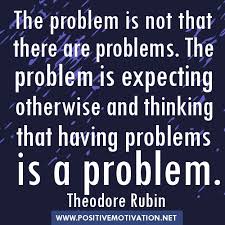
What Wrong With Having Problems?


"The problem is not there are problems. The problem is expecting otherwise and thinking that having problems is a problem." Theodore Rubin

A problem is not a problem until you call it a problem. Before that, it is an occurrence or simply something that happened. Expecting all occurrences to be void of breakdowns/problems is a formula for disappointment.

From another perspective, think of the times you felt you were in the zone. It could have been an athletic event or a business transaction. When you were in the zone, problems had little or no effect on you. You may have looked at them as a slight bump in the road and you proceeded to solve the problem with little or no effort. And then you continued on with your goal.

Later, when you were asked how did you solve the challenge so effortlessly, you may have responded that it was like an outer body experience. And it would have been hard for you to explain. When we are in the zone, problems rarely show up as insurmountable. That's the example of when life is good. So why do people have problems with problems?

Perhaps the real reason we have problems with problems is because we secretly expect them. When they show up, we say, 'I knew something would go wrong'. It's like we programmed ourselves for the disappointment.

When they happen, we are upset because life seems to be filled with one problem after another. And all we want is a smooth harmonious life with no problems. It's like we are waiting for the day that we believe we deserve - a life with no problems. But, as usual, we know the next breakdown is just around the corner.

In fact, we spend time dreaming about the day we meet the right person and find the right job that will give us eternal peace and harmony. While at the same time, our environment has trained us to never get too happy because the next problem is around the corner.

Nevertheless, we have all had the experience of being in the zone. If you focus on doing something well, you will find it much easier to get into the zone. In that space, you will find problems rarely seem to be a problem.


Thursday, 4 May 2017

How to Create a Positive Business Mindset


Plenty of people will give you tips on how to succeed in business. But one of the most permeating and effective ideas is to keep a positive mindset. If you think negatively, you'll often simply discourage yourself and give up too soon. Keeping yourself positive will encourage you to keep going, keep trying, and eventually succeed. Here are just a few ways to turn your frown upside down and jump-start your success.

Positive affirmations: This idea operates under the concept that if you repeat something enough times, you're eventually going to start believing that it's true. While it can seem silly when you get started, it's a proven method of changing your thought processes and giving you a better attitude.

There are a lot of different methods you can use for positive affirmations. A good one is to take time out of each day with a pencil and a piece of paper. Start by writing something positive about yourself. Be sure that what you write is about you, is good and affirming, and is in the present tense. You can continue by coming up with other phrases to say about yourself or by writing the same statement over and over.

To take this one step further, try writing your reactions to your statements next to them on the page. It doesn't matter if your reactions or positive or negative, it just has to be honest about how it makes you feel. Eventually, you'll see your reactions becoming more positive (or at least less negative). That helps you know that you exercises are working and changing your attitude about yourself.

Surround yourself with positives: If you are constantly surrounded by negative people who only focus on the bad things, sooner or later so will you. In your personal and professional life, try to maintain relationships with positive, affirming people. Maybe they aren't successful, but they look on the bright side and make themselves feel successful. Eventually, their good attitude will rub off on you.

Meditation: If things aren't going well for you, or you're constantly surrounded by negative people and ideas, your mind is probably full of lots of thoughts, many of which aren't good. Clearing your mind of all the hassles can help you improve your mood, and meditation is a great way to accomplish this. It also can help you sleep better, feel better physically, relieve pain, and improve concentration.

Visualization: Take a moment to think about why you're doing what you're doing. Is it to make money to buy your dream car, or is it to make enough to send your children to college? Whatever it is, keeping your goals in mind will help motivate you to work harder and keep going. It will keep you thinking about the good things that will happen from your work instead of your current setbacks.

So how do you keep these goals in your mind? Visualize them. If you can picture them, they'll be more real and tangible to you. To help you visualize, you may want to put visual aides in your work space. Find a free piece of wall space and put pictures of your goals in that space - whether it's a picture of the car you want, the house you want, or even just a picture of your children.

Depending on your personality, staying positive might take some work, but it will be worth it in the long run.


Friday, 28 April 2017

Deep Diving Out Of Procrastination


Procrastination - we're all guilty of this. You wouldn't be human if you didn't. So just why do we procrastinate at times? Recent research has revealed that we put off things that we don't like to do. In psychobabble - task averse

When we have tasks to do that we consider unpleasant, unenjoyable, boring, frustrating, difficult or that we resent we are more likely to put these off and avoid them if possible.

This just seems to be common sense and logic so far. What else has the research uncovered? Come on Frank, get to the good stuff!

Okay, you've twisted my arm. The other thing that is important to note from the research is that the way we look at these tasks change over the life of the task. Early on, the more meaningful and purposeful the task is to what we imagine in our lives, the higher we rate that task as enjoyable. Later in the life of that same task what might make them aversive is not having them defined properly.

So, based on the above we might find ourselves needing to have different strategies to finish off the tasks that we have given ourselves!

In very plain English, imagine you have decided that you are going to lose 10Kgs by going to the gym. In the early stages, motivation is quite simple because you still have the main goal in focus. Come day 3 of getting up early for the gym... different story!

What's in it for me?

Simple. We can take this knowledge and apply it accordingly. If you need to get yourself motivated early on in a project, task or goal - make it more meaningful to your overall life goals. This should give you the kick-start that you need at that point in time.

When you find yourself beginning to look at the tasks in front of you with dread later in the project, perhaps remind yourself of what that small piece actually means to you as part of the bigger picture. Secondly, at this part of the journey - make sure that the tasks are clearly defined and structured so that there are no gray areas or uncertainty. Break down any complex task into more easily managed ones.

One Final Thought

Perception is reality.

Thinking that tasks are boring will make them boring.

Thinking that tasks are going to be hard will make them hard.


If you can change the way you look at the tasks in front of you, you will actually change your own behavior.


Thursday, 27 April 2017

Setting Personal Boundaries


A personal space is a space where you hide your own weaknesses, strengths, pain, past, fear, etc. and a boundary is your personal space where you decide, who you want to be, what company you want to be in, what are your motives in life and who are important to you. When you set priorities for each and every person in your life it is the time when you set your personal boundaries. These boundaries show the limits regarding how others can treat or behave around you. Setting boundaries will ensure your protection against emotional and mental exploitation. Healthy boundaries are those that are impartial and reasonable and suitable for one's age and maturity. You can say yes or no without guilt, feel angry or fearful. You can refuse to tolerate abuse or disrespect. Thus, make yourself a unique personality.

Some signs of unhealthy boundaries

1. Talking to someone unknown at an intimate level. 
2. Letting others control your life. 
3. Unreasonably, intentionally hurting someone. 
4. Tolerating false and vulgar remarks. 
5. Letting others set boundaries for you. 
6. Doing something against your family morals, personal values and rights. 
7. Letting others take undue advantage of you. 
8. Tolerating mockery made out of you constantly. 
9. Passing comments without knowing the person's situation and his/her hardships. 
10. Violating other's boundaries.

Tips for setting boundaries

For setting healthy boundaries we need to keep certain things in mind. Due to fear of rejection and loneliness, you hesitate in expressing your feelings and desires. And in order to avoid the conflict and the feeling that you owe them for some reason, you constantly tolerate the disrespectful behavior, hence resulting in becoming a doormat. This happens when you are unable to set your personal boundaries. So, stop being doormat because you are responsible for how you allow others to treat you.

Learn to say No and Stop pleasing others at your own cost. When it comes to your self-respect and dignity then you must not ignore your personal needs, profits and unnecessarily agree to do those things that can harm your well-being.

Using various strategies to set healthy boundaries:

There are some appropriate ways to assert boundaries and you have to follow them one by one according to hardness of the situation.

1. Informing: Firstly we need to calmly make them realize that the way they are behaving is not appropriate. 
2. Requesting: After informing we can request them to lower their voice and try to cool them down. 
3. Instructing: In case the person completely ignores our request, then we must instruct him/her to bring appropriate changes in their behavior. 
4. Warning and demanding: Even after instructing if there is no change in his/her behavior and conduct towards us, then firstly we need to warn them and then command them to change their conduct. 
5. Lastly if there is still no sign of change in behavior then leave the place to avoid further conflict.

Be tactful in some situation, as they are worth letting go, because sometimes your actions can get you into dangerous situation, which are quite difficult to handle. For example while walking down the road, someone whistles or stares you; if you are alone, then it is better to ignore it.

As it is rightly said that if you want respect then you must give respect so, respect other's boundaries, if you want others to respect your boundaries. Respecting other's boundary can help you in becoming more mature, responsible and understanding. Hence

"Discipline yourself to do what is right and important, although difficult, is the high road to pride, self-esteem, and personal satisfaction."- Brain Tracy.


Wednesday, 26 April 2017

Overcoming Envy: What Envy Teaches You


Envy gets a bad rap. The ancient Greek philosopher Antisthenes described it as corrosive ("As iron is eaten away by rust, so the envious are consumed by their own passion.") Envy is established as one of the seven deadly sins - hardly a list of traits that we celebrate.

Yet we all feel it. Envy is part of the human experience. Instead of judging envy as wrong or bad, is there something we can do with it?

Envy begins with social comparison. Social comparison is a psychological process where we try to determine our own personal worth by comparing ourselves to others. So often, the result is we see ourselves as not measuring up.

Research shows that this process of comparison happens continually and automatically, underneath our awareness. And it sets us up for an inevitable deflation of confidence and self-esteem, what I call "compare and despair".

What we may not recognize is how shame is at the root of this despair. Shame is a deeply felt sense that we are defective, inadequate or not good enough. Shame is fuel for envy. When we look at somebody else and feel envy, it's not just that someone has acquired or achieved something, but that we believe we are unable to acquire or achieve something like it.

Well, that stinks.

But, wait. What if there is a positive side to envy?

Because, when we are in despair, we are missing something important: envy is information. Envy is giving you clues about what you desire. Look at your envy to start following the clues. Ask yourself:


Who do I envy?
What is it about them that generates envy?Since social comparison happens so quickly, envy can be vague, like a cloud around the person to whom you are comparing yourself. You feel it but you may not know why.


When you identify the source, envy becomes specific. You can examine it more closely.

Now this is where it gets really good, because envy gives you the opportunity to challenge the assumptions that underlie it.

Consider the source of your envy. Ask yourself:


Is it something I really want?
Do I think I can have it? Or can I attain something similar or create a similar feeling for myself?Let's say, for example, that you envy your neighbors who own a boat. They take their boat out on the water every weekend and it pains you each time they head out on Saturday morning.


Is it the boat you really want (with all of its associated responsibilities like dock fees and storage, maintenance and repairs, insurance and fuel, equipment and supplies)?

Or is it a sense of freedom? wealth? escape? (or something else?) that the boat represents for you?

There is no right or wrong answer - it's about understanding what you really want. Because when you know what you want you can begin to deliberately bring it into your life.

This is how you transform envy, by utilizing it as a tool to help you understand:


What you really want, what you value, what success looks like for you
How you can generate that for yourselfWhen you are clear about what's most important and what it looks like in your life, you can start building it for yourself.


What other people have and do becomes so much less significant. Comparisons won't matter. And you'll be happier when you are focused on your life, rather than on the lives of others.


Source

Thursday, 13 April 2017

5 Ways to Recover From Terrible Failure


Failure can cause one to lose confidence and motivation. Failure can sometimes wreck havoc on our emotions and make us feel depressed. What is worse is that after failing most of us do not always wish to try again because of the negative emotions that we feel. Failure makes us avoid trying again. This can happen on a conscious and unconscious level. It is thus important that you manage what you perceive as failure well in your life to ensure that failure doesn't affect you on an unconscious level and affect your future performance as you try and achieve your goals. Some of the emotions that we experience that affect our ability to take action to create the outcomes that we seek are due to past failures. These emotions may include fear, self-doubt and a lack of confidence.

I have developed a few ways that you can use in your life to recover from failure and heal yourself so that your past failures do not affect your future performance. Here they are:

1. Manage emotions using acceptance

What we perceive as failure can cause us to have a lot of emotional strain. We may experience emotions ranging from anger to sadness and resentment depending on what the situation is. After failing it is not always possible to keep these emotions from affecting us. To recover from failure and keep these emotions under control you need to use acceptance. You need to accept that things did not go well and that there might be consequences to be dealt with from whatever that has happened. Depending on the situation, consequences as the result of failure might vary -; you might be criticised, you might be held accountable, you might have lost money, you might lose your self-confidence, you might lose your job or business. Whatever it is and whatever the consequences are, drive yourself towards acceptance because this is the only way in which you will better find creative solutions to the challenges that you might be facing. It is tempting when we face challenges to dwell on the emotional pain, to think and go over what ifs but ultimately we have no choice but to make decisions and act if we are to change our circumstances.

2. View failure as an isolated incident not an inclusive incident

In our lives sometimes we have what I call "cross contamination". When one area of our lives isn't working as well we wish it could, the unhappiness and emotional strain that we experience from the area which isn't working well gets carried across other areas of our lives. We begin to feel like nothing else in our lives is working. Cross contamination causes us to carry emotional strain from work or business to our family lives and ultimately to our health and well being. The opposite can happen as emotional strain from our family lives can sometimes extend to our workplace and ultimately our well being depending on how we respond to the problems that we face.

You need to view the specific failure that you are recovering from as an isolated incident in order to stop this from straining other areas in your life. This is not easy to do as sometimes having a bad day at work can mean a bad evening with the family or vice versa. However, if you learn to better manage your emotions and isolate problems in various areas of your life, you might be in a better position to prevent emotional strain from one area of your life to cross contaminate all other areas of your life. This can only be done through improved self-awareness and emotional discipline.

Sometimes failing in a specific area can make you feel as if you failing at everything. You need to be aware that failure in a specific area in your life doesn't mean that you will fail on every other area. So see each failure as specific and not inclusive.

3. View failure as feedback from your specific actions

After following step 1 and 2 above you should begin to be in a better emotional state to think constructively about what went wrong and what has not worked well to cause the outcomes that you did not want. With this improved emotional state you should now use failure as a learning by analyzing what really went wrong and what actions you could have taken to improve your results. Most failures are due to a lack of planning, processes that did not work well, unforeseen circumstances, failure to be pro-active and so on. This is now time for you to diagnose what didn't work with clear emotions and an open mind. So assess what went wrong and identify things that need to be improved for you to create better results in the future.

4. Commit to new actions

After diagnosing your failure and receiving feedback from it you need to commit yourself to new actions in order to fully recover from your failure. Ask yourself what you will do and no longer do as a result of the feedback you received from your failure then commit yourself to new resolutions. You can list things you will do such as early planning, better communication, improve processes etc. Listing things that you will no longer do that might have caused you to fail is as important. So also list things that you will not do in the future such as procrastinating, avoiding administrative work, communicating poorly and so on.

What is important to note is that committing to new actions will also give you an emotional boost and hope. Often when we are in distress just thinking of the next practical step to take is enough to help us have hope for better future results.

5. Remember your past successes

Remembering things you did well in the past can help you gather strength to recover from immediate failure. Have things worked well in the past? Is there historical performance that you can look to and be proud of? if so, list these great achievements and performances and make them more prominent in your mind. Remember how you felt when things worked well and rekindle these feelings to gather strength to overcome present challenges. This will help you regain your self-confidence as you plan how to better deal with the future.


Imagine what your life would be like if you had self-confidence and did not hesitate to act and create all the outcomes that you want in life. Picture yourself believing in yourself and becoming exactly who you want to be. A successful man or woman who is happy doing things that he or she loves and has great relationships. No more would you have to suffer from second guessing yourself and taking the back seat, criticizing yourself or enduring the pain of those that criticize you and do not appreciate you...


Plus-You Can Now Join Our FREE Mastering Success Facebook Community at www.masteringsuccess.group


Thursday, 6 April 2017

Science of Success - Achievement


When I was younger and still naive I had big dreams and always thought of having anything I wanted and being anything I wanted to be. However just like many other people from all walks of life I was told you can't do this or you can't do that, basically being told that I can not be a success.

I just needed to get a job and work hard, basically going along with the herd. Fact is I was already a success in my own little way at that time and as I am now even a bigger success in my own right today and I will always be a success in one form or the other.

I guess in a way hearing that I couldn't do this or couldn't do that was the motivation that I needed to push me to excel in whatever is was that I tried to do and not give up when obstacles appeared in my path. Achievement at no matter what I was attempting was always my ultimate goal.

As I grew older and I like to think a lot wiser I sought out self help books, cd's, dvd's, and listened to motivational speakers to work on my own personal development because I knew that I had to learn self motivation to push myself when times got difficult and setbacks occurred because they will occur its those times you have to push harder to overcome them.

Some of the greatest achievements throughout history happened usually shortly after the biggest setback had occurred as well as many individuals dreams cut short because people gave up too soon when the obstacles appeared to big to overcome and these people learn later to their dismay if they would have only stayed the course a little while longer they would have succeeded. That is why it is so important to not give up during those times.

That is why it's important to seek out those that are having the kind of success that you wish to have and take inspiration from that to acquire it for yourself as well.

Success is different for everyone and everyone reaches it in different ways but overall there are common denominators to people that achieve success and those that do not.

Growing up I am sure you heard just like I did, work hard and you will be success. Well there are many people that work extremely hard and they do not have the success they wish and are struggling to make it day to day. If hard work brought success and wealth we all wish to have then everyone that did hard physical manual labor would be rich. It is just not so.

Fact is that being successful is not about doing certain things, it's about doing things in a certain way. There is a science to success. 
Here quick list of the common denominators of successful people.

1. Taking Action

2. Passion and Desire

3. Discomfort. I am not talking pain here but they are able to leave their comfort zone and be uncomfortable, they push through their weaknesses and overcome.

4. Vision

5. Decision Makers

6. Control Emotions

7. Consistent

8. Logical

9. Practical

10. Talent

Now go back and read that list again and pay particular attention to the first common denominator because without doing it, all the rest are useless.


Plus-You Can Now Join Our FREE Mastering Success Facebook Community at www.masteringsuccess.group


Sunday, 2 April 2017

Get Self Confidence in 5 Steps


It is important to be confident. Being confident, means to be secure in who you are and being certain in the decisions you make. Being confident in your abilities means that you are positive about yourself and it is this self confidence that make other people have trust on you. More sure you are about your skills, will make other people have more confidence on you. Self confidence goes a long way. From seeing everything in positive light, self confidence helps in career as well as life opportunities.

Every person is not born with the skill of self confidence but it is ability that can be groomed with a little dedication. Here are 5 pointers for boosting your confidence in yourself:


Concentrate on Positivity


Revaluate your life and take a break from the people who take you and your self confidence to a low. Try focusing on the solutions rather than the problems. Even if there is nothing going right, keep in mind that one day it will. Stay positive and concentrate on the silver lining in the dark clouds. It's your life and to enjoy it you have to stay positive and let go of negativity and negative people around you. Remember that after every rainy day, sun comes out.


Change in Body Language


It is said that people takes more cues from non-verbal language that is body language rather than verbal language. It is very necessary to have a good and agreeable body posture that shows your confidence. The straightforward task of pulling shoulders back provides a sense of confidence to you and lets other person see that you have confidence in your own abilities. Smiling and maintaining eye contact makes the other person comfortable around you.


Never Accept Failure


Don't accept failure and never give up. The act of accepting the failure shows that you can be easily defeated by your defeats and have no confidence in yourself. Follow the old saying of "Try and Try again and Never Quit". More you get challenged by a particular problem work hard and make sure that you try and complete the task. If you are continuously knocking yourself down with your negative thoughts, you are becoming what you are sermonizing within your head. Next time you think negatively, substitute it straight away for a positive assertion.


Always Be Prepared


Whether you go out for a job interview or you are working on a new project, learn to be always prepared. Discover everything, there is to know about your line of work, work, projects and more. Whatever maybe on your "to conquer" list, it is important that you always be prepared for all the setbacks and triumphs. If you are geared up, and have the skill to back it up, your self confidence will rise.


Create Accomplishment List


Life is full of trials and there are times when it's hard to keep our self confidence up. In those times, sit down and make a list of all the points in your life that you are thankful for and list of all the things you are proud of accomplishing. Once your lists are complete, keep them by your desk and always be reminded of what a marvelous life you have and what an incredible person you really are.

With these five steps, you can boost your self confidence and turn a new page of your life. Remember have trust in your abilities and your self confidence will show.


Plus-You Can Now Join Our FREE Mastering Success Facebook Community at www.masteringsuccess.group


Saturday, 28 January 2017

How You Can Succeed like Others Who Have Succeeded


We can easily be intimidated by successful individuals; their wealth and achievements seem unattainable, and their personality appears to be unique. It can also be discouraging to know that there is a big gap between you and some of the distinguished people in your industry.

You might even question whether you have the ability to replicate that success or if you can ever reach those levels to begin with. You should not be discouraged by the seemingly distant success of others. Instead, consider these tips to help you achieve success in your own right:
Be Yourself


It may sound contradictory, but if you want to succeed like the people who have achieved massive success in your industry and inspired you so much, you need to be nothing like them. Well, almost.

To succeed in just about any field, whether it’s sports, arts or business, you need to be yourself and avoid imitating anybody who has already made it. Replicas will never have the same credibility as the originals.

If you imitate others, sooner or later, you’ll be found out. And once you’ve lost credibility, it can be very difficult to gain it back. Let’s look at the arts, for example. How many tribute acts do you know that are more successful than the musical icons that they imitate? The answer is probably zero. That’s because audiences can see through the frailty of imitation. On the other hand, a lot of new artists are still able to break through the market and become massive successes—imitation free.
My Early Years

When I started out in this industry, there was a huge gulf between me and those who I saw on stage when attending events. They had all the charisma and personality that seemed to come naturally with top-earners. I, on the other hand, was a shy young man. I kept asking myself, “Do I have to be like them in order to succeed?”

In those early years, I was trying to be something or someone I wasn’t. I was trying to be the typical internet marketing guru with all the trimmings. It was forced, unnatural, and quite evidently, awful. But with time came experience. In early 2013, I decided to “be myself” and stopped trying to be what I thought was the blueprint for a successful internet marketer.

I subsequently got good feedback from audiences who liked my honest and forthright approach. I was transparent and true to myself. This gave me a lot of confidence and the rest, as they say, is history.
Communicate with Conviction

If you want to succeed in business, you need to clearly communicate with your audience. While keeping your voice and individuality is extremely important, keep in mind that you should have conviction along with a conversational and friendly tone when talking to your customers or clients.

I personally believe that it’s effective to talk to your prospects during training or seminars like you would your niece or nephew. You can be friendly and personal while remaining authoritative and educative. Remember, you will only succeed in this business if you portray a position of value.

Communicating with your audience in this manner can come in the form of:
Writing (having an authoritative, engaging, personal and friendly tone.)
Video (confidently speaking to your audience, yet remaining “watchable.”)

It’s important to show your personality in videos and be authentic because your audience will be more inclined to connect with you if they see the person behind the words. A Forbes study found that 75 percent of executives watch work-related video content on business websites at least once a week. And out of those, 65 percent of them said they visit the marketer’s website after watching the video.

If you copy someone else’s technique or personality, it’s highly unlikely that the 65 percent will follow and connect with you.
Conclusion

If you think that you can only succeed in business by imitating industry leaders, you need to remember one important piece of advice: There will always be a segment of the market that will resonate with what you have to offer. Just as you resonated with the industry leaders that inspire you, there will be others who connect with and are inspired by who you are and what you do.

Thursday, 26 January 2017

How To Handle With Your Negative Thoughts


Do you often find yourself overwhelmed with negative thoughts? Do you even notice that you have a habit of contemplating on the worst case scenarios? Are you paralyzed by fear and unable to take action on things you know you should do?

And most important, have you ever questioned yourself on how you can stop yourself from being so negative?

Maybe you've just allowed yourself fall into the habit of seeking solace in negative thoughts. Whether we realize it or not, there's a comfort in negativity that's just not always there in a positive outlook. Does that sound paradoxical?

Being positive requires courage. It's an ability to accept mistakes fully and claim ownership of them.

It means living in a certain amount of discomfort. It means leaning towards your edge of comfort zone and expanding it daily. It means choosing what's possible instead of what's known.

The truth about life is that personal growth can only occurs when we grow through discomfort and find the next place of discomfort to navigate.

That's fine when we look at someone who tends to drown themselves in a kind of helplessness, but most people get scared when they experience anything remotely involving a negative thought. They have a negative thought that feeling discomfort means they are about to become depressed and they won't be able to get out of that emotional state.

Such people would do well to stop attaching themselves to random emotions. The emotion might come and go, but has no effect on the person unless they choose to grab hold of it.

Either way, the biggest mistake people make is to see negativity and positivity as polar opposites.

Black and white. Right or wrong. Yes or no.

The world is full of multiple shades of grey, and a healthy approach would be to remain mindful of 2 facts:

#1 Everything has flaws, no matter how perfect it seems from the outside. 
#2 Every flaw has positive features, no matter how defected they look from the outside.

By remaining realistic this way, it's much easier to experience emotions as steady, rather than disruptive mood swings.

So, forget about just trying to make yourself be positive, like jamming a square peg into a round hole.

Instead, begin looking at everything that's positive as a force for good in your life, and everything that's negative as a minor stimulus for you to grow.

How your emotions affect you depend on how much you actively allow them to do so.

Don't allow something temporary take hold of how you feel generally about something. A momentary, impulsive behaviour on the part of your friends wouldn't influence you to cease your friendship forever, so why would you allow a momentary feeling of negativity influence you to maintain a negative outlook of the world for the rest of your life?


Friday, 20 January 2017

5 Barriers That You Need to Cross to Achieve Success in 2017


It is a fact that success is achieved with a lot of hard work, struggle and persistence. However, one important factor that is usually ignored is mental strength. Some people are generally good when it comes to emotional stability or mental strength, however, others can work on it to make it better.

Mental and emotional strength can be developed with proper focus on it. However, to work on the development of emotional strength, it is important to analyze how you are spending your time. This will help you explore things that you need to quit doing and things that you need to work on.
Here are 5 barriers that you put into your own path:


1. Jealousy

When an individual decides to analyze and focus on other people’s blessings, this is where jealousy acts as a barrier to an individual’s own success. If you want to achieve success and mental peace, then it is very important to focus on things that you possess rather than things you don’t own. Moreover, somebody else’s luck cannot take anything away from you. Jealousy is an illusion and a barrier to success.


“Jealousy is the tribute mediocrity pays to genius.” – Fulton J. Sheen

2. Seeking perfectionism

It is observed that individuals delay things as they seek perfectionism. It is important to understand that perfectionism is actually underestimating yourself that you are not good enough. Perfectionism acts as a barrier to success. It leads an individual to depression and anxiety. It is important to overcome this barrier in order to gain success in 2017.

3. Comparing yourself to others


A true waste of time, effort and resources is comparing yourself to others. Successful people would never do it as they know that they are one of a kind. So if you really want to compare anything, it must be what you have achieved and what you are willing to achieve. Overcome this obstacle to achieve success in 2017.

4. Blaming others


It is a common attribute where an individual takes all the credit for the achievements and success. However, when things don’t work out then it gets easier for an individual to blame others. Blaming others for your failures is actually the biggest obstacle to success. You need to stop blaming others and starting focusing on solving the problems if you are really looking forward to achieve success in 2017.


“Your life is the fruit of your own doing. You have no one to blame but yourself.” – Joseph Campbell

5. Doubting yourself

Commonly, people doubt themselves on various occasions or instances. Where there is a doubt, there is no way. Hence, whenever a doubt comes in your mind, then it is time to remember all the things you have achieved. To overcome doubting yourself, it is important to remember the distance you have covered to be where you are today. Stop doubting yourself because it holds you back from moving forward.

Crossing these 5 barriers will help you gain mental and emotional strength. With enhanced and improved mental strength, you are going to be more powerful at work. This will definitely help you to overcome a lot of your weaknesses. In fact, it can be all that you require to achieve success in 2017.

Tuesday, 10 January 2017

5 Reasons Why You Need to Fail Before Tasting Success


Failure, a word everyone fears. Nobody wants to fail no matter what the field is, what the situation is or who the opposition is. Everyone looks to evade this threatening word.

But, is it really a threat? Or have people made it one?

Since our childhood, we have heard that it is not right to fail, whether it’s your academics, a sporting affair or anything else. Society has created an ecosystem where failure is considered as a curse rather than a blessing.

We are taught to hide our failures from our friends, closed ones and relatives, which let us assume that failure should not happen.


As they say, if you haven’t failed in your life, it means you haven’t tried anything new or you haven’t come out of your comfort zone. And rightly said. Unless you go out of the way to try out new things you’ll not witness failure.


5 Reasons Why You Need to Fail Before Tasting Success

It is important to fail in life. It teaches us some of the incredible life lessons, which not only make you a stronger human being but also bring out the best in you.

People fail and they do fail time after time. Consider examples from the past and you’ll get to know that every successful entrepreneur has failed at least once.

But, what makes them stand apart from the crowd is their dedication, zeal and passion for beating the past, hence, every time they fell, they stood up, fought and eventually succeeded.

It’s important to note that ‘Failure isn’t the end’. Instead, it is a necessary stepping-stone in one’s life before the accomplishment of dreams, desires and hopes.

The startup balloon is continuously inflating where entrepreneurs are trying to leave no stone un-turned in order to achieve the impossible. It is an inevitable fact that startups are prone to failures and only a handful of them, who wish to persistently work on their dreams and goals, are able to rise.

Here are five compelling reasons why failure is necessary:


1. Eradicates the Fear of Failure

Failure scares the s*** out of you. Doesn’t it?

Everyone is scared to fail, lose or stall. But, once you face that situation in your life, you won’t be scared of it anymore. The early you fail in your career or in the journey to building a startup, the better it would be for you to eradicate the fear of the unknown.

Failure is unavoidable. Whether you try or you don’t, failure will come to you in some way or the other. Failing without trying is something like not winning a marathon without participating.


You didn’t try just because you were scared of failing is the lamest thing you’ll ever do in your life. You’ve got a life for a purpose. Dream big, work hard to accomplish your goals and no matter if you fail or lose. At least you’ll be content with your efforts in the end. Plus, you’ll always be one step ahead of those who never tried.

There lies enough thinness in the fact that you will not fail.

You will and once you’ll face the hardship of it, you’ll stand, contest and win because you have to. In the midst of all this chaos, you’ll realize that nothing fell apart and you will emerge as a person who is as brave as a warrior. You’ll be ready to take up any challenge in your life without being afraid of failure.


2. Makes You More Mature

Overcoming a tough phase in life, be it during your startup journey, your love life or your professional life isn’t facile. It requires a lot of strength, focus and will. But, once you are out of it, everything looks bright and shining.

Failure is an experience which lets you learn important life lessons and explore new opportunities, which eventually make you a stronger and more mature person than before. The lessons learnt from any life situation are flexible to implement in different phases of life.

All you need is to identify the crux and gist of the same.


3. Brings Out Your Real Potential

Success can’t be achieved overnight. It is a prolonged process involving your passion, hard work, zeal and dedication along the path you have chosen. Life tests you on every turn. There are hurdles, obstacles and struggles that aren’t avoidable.

You need to cross each one of them to become a winner, which is what lets your real inner potential break free.


You’ll be tested inside and out during the course of the success path and it will only be your positive attitude, zing and passion of how badly you want it. If you hold the power to withstand all the unpredictable notions of life, then you’ll win. Otherwise you’ll fail.

4. Takes You Closer to Perfection


If you fail more than once while thriving to win, then it’s, fortunately, a positive sign. The more attempts you’ll make to cross the ultimate line, the higher the chance of you building a revolutionary product.

With every failed attempt, you’ll thrive to build better. Your efforts are likely to multiply after every failed attempt. It won’t be a surprise if you manage to build an extraordinary product which becomes the first of its kind worldwide.

5. Enhances Your Urge to Achieve


You fail once or you fail twice; but every time you’ll be standing in the middle of a two-way road. One will be pointing you to try again even harder, while the other will be pushing you to switch to another endeavour.

Whatever may be your choice at that instant of time, your urge to achieve will be on a higher side. You’ll want to accomplish your goals, achieve your dreams and make your dream, a reality.


Final words

Since our childhood we have tried to escape failure and look out to people with failures under their belt in the most ungracious way possible. As if failure is a curse.

This is what we are trying to change. Consider failure as a blessing rather than a curse and trust me; the world will become a better place to live in.

If you are passionate about your idea (a startup, a new project or a new venture), you’ll find a way to cross the line.

Millionaires have failed too (not once but quite a few times), they have also switched paths, they have also crossed a road full of barriers, but the difference they made during their journey to success was the inexorable passion for making it large, which they eventually managed to do.

Now it’s your turn to deter failure and rise above all!