Showing posts with label women. Show all posts

Friday, 5 May 2017

What Wrong With Having Problems?


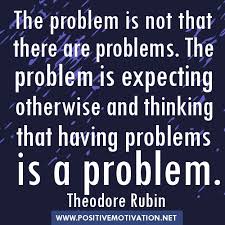
"The problem is not there are problems. The problem is expecting otherwise and thinking that having problems is a problem." Theodore Rubin

A problem is not a problem until you call it a problem. Before that, it is an occurrence or simply something that happened. Expecting all occurrences to be void of breakdowns/problems is a formula for disappointment.

From another perspective, think of the times you felt you were in the zone. It could have been an athletic event or a business transaction. When you were in the zone, problems had little or no effect on you. You may have looked at them as a slight bump in the road and you proceeded to solve the problem with little or no effort. And then you continued on with your goal.

Later, when you were asked how did you solve the challenge so effortlessly, you may have responded that it was like an outer body experience. And it would have been hard for you to explain. When we are in the zone, problems rarely show up as insurmountable. That's the example of when life is good. So why do people have problems with problems?

Perhaps the real reason we have problems with problems is because we secretly expect them. When they show up, we say, 'I knew something would go wrong'. It's like we programmed ourselves for the disappointment.

When they happen, we are upset because life seems to be filled with one problem after another. And all we want is a smooth harmonious life with no problems. It's like we are waiting for the day that we believe we deserve - a life with no problems. But, as usual, we know the next breakdown is just around the corner.

In fact, we spend time dreaming about the day we meet the right person and find the right job that will give us eternal peace and harmony. While at the same time, our environment has trained us to never get too happy because the next problem is around the corner.

Nevertheless, we have all had the experience of being in the zone. If you focus on doing something well, you will find it much easier to get into the zone. In that space, you will find problems rarely seem to be a problem.


Sunday, 30 April 2017

Think Your Way to a Better Life


Our thoughts are extremely powerful and either get us where we want to go or hinder us and hold us back from what we want to achieve so how do we think our way to a better life?

1. Realize the Importance of the Way you Think

I think the first step has to be realizing how influential your thoughts are in getting what you want out of life. If you realize their importance then you will make more effort in controlling your thoughts and focussing on the positive; if you don't realize their importance then you may just let your mind wander wherever is more natural for you and that may not be where you want to go. We need to take control of our thoughts before we can make them act for our good.

2. Take Note of Negative Thought Patterns and Take Steps to Overcome Them

Once you understand the important of your thoughts it is time to start taking note of your negative thought patterns that do not help you achieve what you want in life. Are you a procrastinator? Do you think that you will put off until tomorrow what should have been done yesterday? Do you commit self-sabotage? Do you think yourself into not succeeding at anything because you don't believe you will? Does negativity drain you of any energy you could put into more positive action? All of these thought patterns can be overcome and your mind can be trained to think right.

3. The Power of Affirmations and Visualization

Not only do you need to overcome negative thought patterns but you also need to train yourself to think positively and the best tools for this are visualization and affirmation. Visualization focusses you on what you want to achieve. It is a deliberate thinking about where you want to be. Affirmations fill your mind with positive thoughts and confessions and help you think positively and go after what you want in life. Picture yourself where you want to be instead of focussing on what you don't want in your life.

Why is Positive Thinking so Important Anyway?

In the first point I said you need to realize the importance of positive thinking, but why is it important? The fact is that when we focus on the negative we are drained of all energy and will become depressed and find it difficult to achieve the things we want to achieve. When we focus on what we want to become we find ways of making it happen. We have more energy to carry out the plans we develop for achieving our goals and gradually our life becomes totally different as we take these small actions and change the way we think.

Start taking control of your thoughts today - think positively, develop plans and visualize where you want to be instead of focusing on where you are. 

Before anything can happen it needs to begin as a thought; so think right.


Wednesday, 12 April 2017

Monsters and Molehills


'Molehills in life are bumps in the road; they become monsters when we accept them as powerful truth, allowing them to become monsters chasing us through life. Molehills like the teacher who could not find anything redeeming in the student and carelessly flung demeaning insults, leaving behind a child who believed every word they said and became what they believed. The molehill became a monster that chased the child relentlessly through life, one failure after another.

Molehills are the path of destruction left after something uninvited digs its way through our sub conscious mind leaving a tunnel of doubt and a path of fear that somewhere in that dark tunnel lies the truth about who we will become. What we believe may be the most important block in our foundation. Even the greatest of blessings cannot be delivered if we cannot believe; we must believe to receive. Harboring the fear that we do not deserve or cannot achieve something that is important to us will ensure that we cannot.

Damage that begins in childhood plants deeper roots in our subconscious; it has a long time to grow and dig in. A child is born believing in goodness, it simply knows no other way. Trust has brought the child to this new beginning with a fragile defense system in place. In the absence of steady and positive reinforcement of encouraging truth and what can be, it is far easier for a child to believe what they see and hear, to begin to grow from those ideas. Sadly this is frequently the beginning of a long and difficult road filled with doubt, self-recriminations and fear of rejection that keeps the best in life at bay. The good things were never unattainable; they just became a mirage that could not be touched.

Sometimes there is no one to provide the kind of direction and reinforcement we need to escape from the monsters. How can we defeat something we believe is more powerful than us? Only by standing still and objectively looking at the monster, without any emotion. Emotion colors what we see and creates a binding force that ties us to the monster. Pain creates trauma; trauma is one of the strongest emotional bonds. It is necessary to tear the wound back open and stop pretending that we don't really care about things that matter a lot.

This leaves us vulnerable; vulnerable to the same pain, the same wrong ideas and yes, vulnerable to receiving the best that we can believe in. It is this that makes it worth the effort of tearing it open and re-examining without emotion what really happened. When we can do this, we can believe in ourselves and the best that life can provide for us, leaving the monster powerless. Like a shape-shifter it fades back into the molehill it always was, just a bump in the road. This is all that is necessary to be free to receive the best we can believe in.

Plus-You Can Now Join Our FREE Mastering Success Facebook Community at www.masteringsuccess.group


Sunday, 9 April 2017

How Do We Know If We Can Trust Someone?


Many of us trust too easily only to discover that we were betrayed. Others of us don't trust at all. Trusting too quickly, or not trusting at all, usually says more about us than about the other person. Trust is not something that we want to automatically do when we meet someone. We also don't want to automatically mistrust someone either. Some of us experience an involuntary response to trust, or not to trust, and neither one of these extremes serve us well.

Trust is something that takes time. It's a process.

Trust is a process

When I say, trust is a process, it means that it takes time to get to know someone. If we enter a relationship at a slow and steady pace, we will discover more about who the other person's true self. We can then determine whether they can be trusted with our feelings, and our shared personal information, because our trust is the greatest gift we can give someone.

Finding the Balance

Some of us were betrayed early in life, and we don't trust easily because of that. Others so desperately want to be in a relationship, or a friendship, that we rush to trust someone to make that happen. We don't give ourselves the opportunity, and time, to get to know that person to determine if they are trustworthy, or not.

In adulthood, often not being able to trust a friend, or a potential romantic partner, may be because we have been betrayed in our childhood, adolescence, or at some time as an adult. The person desiring our trust may very well be trustworthy, however we may not be able to recognize this due to our history.

Our Past Relationships Reflected in The Present

One of the first big tasks of our lives is establishing trust versus mistrust. As a child, we develop a sense that our needs will be met, versus a sense that they won't. Our view of the world is often determined by how secure we feel that we can rely on others for our expectations to be met. If we have had good, consistent relationships in the past, we may assume as much from our current and future relationships, and trust too easily based upon this experience.

If our parents, or our experiences in past relationships, were inconsistent in meeting our needs, we may fear current and future relationships will respond the same way. We make ourselves vulnerable when we trust. Withholding our trust may be used as self-preservation to protect us from being hurt again. How can I trust myself from past mistakes?

It's Not You, It's Me

Sometimes it is challenging to differentiate to determine if we are not feeling trustworthy of someone else. Is it about them? Or is it about our own history? So many times, I have heard during psychotherapy sessions that, "My friend is talking about other people and I'm uncomfortable. I don't know if I ought to trust them or not."


Plus-You Can Now Join Our FREE Mastering Success Facebook Community at www.masteringsuccess.group


Wednesday, 29 March 2017

3 Reasons to Carve Out Time Each Day for Yourself and Increase Your Productivity


"I have no time to myself" this is a common refrain by everyone.

Now ask yourself this question, whose fault is it?

First, you have to accept that personal time is a necessity, not a luxury or you will never leave yourself any. This is a growing problem that will even affect your productivity and your health. Let me explain.

One of the most effective ways to manage this is to actually make an appointment with yourself. Block time on your calendar for taking yourself out to lunch, a 30-minute soaking bath, an hour at the library, or at your favorite coffee café. Then treat this like any other high priority appointment and keep it with a vengeance and determination. This is for your mental, emotional and physical wellbeing.

Schedule other appointments like this one through out the month, do not a standard Saturday afternoon one hour once a week slot, this routine will become too common place and will disregard the importance of it. You must think of this as a priority and something to look forward to and plan.

We all need some kind of break each day, to getaway from work, chores, and people, even family. Use your great brain and calmly think of creative ways to make time for you. Perhaps at first your family will need a bit of explaining to understand that you are doing something for them as well as for you and you are not selfish. While you are explaining you are also defusing any guilt that might surface, nurturers are notorious for self-imposed guilt.

Depriving yourself of "me time" will only leave your feeling ornery, resentful and stressed out.

Your stressful emotions will spill over onto your family, friends and other relationships. They will feel that something is wrong and they will absorb your stress.

Knowing that your emotions influence others, you have choices to make. You can be grouchy, resentful, negative, stressed and difficult to be around or you can be pleasant, loving caring calm, happy and a productive fostering healthy relationships.

Besides, how else can we properly evaluate what we are doing, see the big picture, and appreciate those we love, unless we stand back from them once in awhile.

This standing back allows you to put your daily life in to perceptive and you gain patience and calmness. Once you have your daily agenda controlled, you can start on the weekly strategies. This will be an ongoing process but a happier, healthier life is worth it.

Take your allotted number of time outs, this time out ideas are a natural way of managing your stress and becoming comfortable with nurturing you. 

Nurturing the nurturer is a major method in naturally managing your stress.


Plus-You Can Now Join Our FREE Mastering Success Facebook Community at www.masteringsuccess.group


Thursday, 16 March 2017

Patience, Understanding And Tolerance


Nothing is free and it all comes from somewhere and something. Everything worthwhile takes patience, understanding and tolerance to build. Without those qualities, you or anyone are like the playful grasshopper that cannot build an ant hill, and you just jump around impatiently. Without understanding, combined with that impatience, you end up freezing in the cold with total "I want to have fun in the present" intolerance just like the grasshopper in the old fable about the ant and the grasshopper.

I am not saying be overly cautious and save your whole life for the afterlife, but I am saying that you should make prudent choices that include patience, understanding and tolerance with them and in them. In short: Be rationally flexible and all else will be added to your life ultimately.

Let me go into what I mean by that word "ultimately": I mean the sum total of all your rational actions in existence and consciousness that are for total and completely beneficial to you, not those actions that feed you today and fill your immediate needs now and only now.

Now, that I have told you what I meant by "ultimately", you can breathe a sigh of relief that I am not telling you to save your whole life and future better existence for a "rainy day" and I am not telling you to take a "rain check" on what is currently going on, however undesirable or not ideal it seems.

So, do not lend me your minds, use your mind to make a better now and later out of the past, meaning learn from the past but do not live in it. Take from this article what is valuable and use it in your own life well. I am not an authority, I am not perfect or even great. I simply observe and write down "what is up" with it all realistically. That is it.

Listen, like anyone, I want to be wonderful, great, perfect and all of that at times when I miss the mark, like anyone. But, those times I miss the mark are valuable because I learn to be better and actually end up better. That is tolerance. As for patience and understanding, that is why I put them before the tolerance in the title, because you must have those first to get to tolerance. Indeed, life is as good as we make it through those three things. For, faking it until we make it never works, and it is real cheating anyway. Being real all the way through is where it is at and is "the real easy way" anyway. When you cheat, even if you succeed, what you skipped comes back to haunt you anyway. So, why not be real through genuine patience, understanding and tolerance anyway. The best way is the real way.


Plus-You Can Now Join Our FREE Mastering Success Facebook Community at www.masteringsuccess.group


Wednesday, 15 March 2017

Why Small Wins Create Huge Success


If you are the kind of ambitious, bold-thinking, courageous high level achiever, you probably are a serious action taker who understands the essence and importance of daily personal growth and development.

A daily habit of self-improvement is one of the golden keys to consistent success. This kind of self-investment will lead you to become more successful, attractive, productive, courageous, happier, healthier and more fulfilling life.

As Jim Rohn taught me, if you want to have more, you have to become more. For things to change, you have to change. For things to improve, you have to improve.

The level of success we experience in our outer world is simply the mirror reflection of our self-identity and personal development of our inner world.

So when you raise your personal development set points (self-identity, mindsets, attitudes, philosophy, skills and abilities), everything in your life will be raised automatically.

However, some people approach this self-improvement process in a wrong way, which sabotaged their time, energy and efforts to succeed.

For instance, many of us are under the assumption that the best types of changes we can make are those 'big steps'.

You probably have heard about terms like 'turn over a new leaf' and 'start afresh' as if we could just hit a 'reset' button like a computer and everything will become clean and perfect right away.

In reality, the most effective, long-term, sustainable kind of self-improvement always involves taking small, tiny, seemingly insignificant steps day in and day out.

Breaking out of old destructive habits and introducing new habits into our routine are very difficult and the whole process requires a lot of effort.

Habits are formed when certain actions get repeated over time, and those neural connections in our brain will be strengthened every time they are instructed to fire the signal.

It's like creating a deep groove and then running water along the surface - it gravitates to the groove.

When you're trying to change a habit, you're exerting a lot of energy to go against this natural inclination of existing neural pathways whenever you perform the new action. Thus, you need a lot of focus, dedication and willpower if you truly want to change.

So if you're trying to change 27 things at once, or if you're going from no exercise to exercising 2 hours every day for 6 times a week, you're setting yourself up for failure.

Additionally, when you are overloaded with excessive information, your brain won't be able to process them and you will be shut down to take any kinds of action at all. So you remain as the same old self!

So the best way of creating lasting changing is almost always changing just 1 tiny thing at a time - be it getting rid of certain behaviors or adding a new empowering success habit.

This will make your entire body mechanism much easier to handle the transition when you shift from failure to success over time.

With enough consistency, persistence and patience, you will build up great positive success habits over time and you'll start to experience massive success you've always desired.


Plus-You Can Now Join Our FREE Mastering Success Facebook Community at www.masteringsuccess.group


Sunday, 12 March 2017

Three Steps to Beating Stress


The body's natural flight or fight response to stress is designed to protect vital functions from attack until the threat is gone. It does this by pumping hormones into the blood stream, mainly cortisol. The boost in cortisol helps to heighten your alertness and shift energy to essential bodily functions, temporarily. One of the functions that has energy removed from it during stressful periods is the digestive system. The body slows down the energy required to process and digest food in the digestive tract until the stress period is over.

You may have experienced unpleasant reactions, like stomach aches and diarrhea, in your gut in response to immediate stresses. If you remain in a heightened stressful state over a long period, the elevated cortisol levels and stress-response systems can cause significant damage to your body. Stress can also make existing digestive problems worse, leading to more abdominal pain, nausea and heartburn. According to the National Institutes of Health, one in five Americans has a common and very uncomfortable digestive malady, irritable bowel syndrome (IBS), which produces pain, bloating and sometimes diarrhea and constipation.

Many of these digestive problems appear to react or to become more pronounced in response to stress events. The continuing discomfort can affect your mood and it can affect your health. In addition to IBS, you may experience indigestion as another disorder affected by stress. Feeling bloated and wanting to throw up for no apparent reason may be a symptom of a stress response. When the stress is gone, these symptoms disappear. You may also experience heartburn as the stomach may cause the stomach to produce more acid. If your diet contributes to heartburn issues, stress can only make it worse.

When your digestive processes are disrupted, you may create an unbalanced bacterial population, starting in your stomach. This can lead to a growth of the bacteria that lead to ulcers and may worsen ailments where inflammation or infections are present, such as Crohn's disease. Sustained stress can result in a variety of undesirable physical and functional disorders. While all of this is occurring, your body's immune system is compromised for two reasons. The heightened cortisol levels helps to suppress your immune system as part of the stress response. A poorly functioning digestive system will not be able to extract nutrients from your food, which further degrades your body's ability to remain strong and cope with the stress.

It is not possible to avoid all stress-producing events. Life goes on around us and we feel as if we are on a roller coaster with emotional ups and downs with each new turn. However, we can take some important steps to keep our bodies working optimally by reducing the stress levels and improving our ability to recover from these events. The first thing to think about is a walking timeout. Whenever possible, at the first sign of stress, try to take a walk of no less than ten minutes. Exercise helps to re-balance your hormones and keep you on an even keel. Walking near trees and grass will further stimulate positive reactions in your brain, which will help you to relax.

Next, make sure your diet is packed with a diverse range of nutrient rich vegetables, fruits and proteins. Remove processed sugars and starches from your diet as much as possible. The excess sugar helps to promote inflammation and digestive issues. Finally, add a good multi-species probiotic to your diet, including plain sugar free yogurt or kefir to help boost the population of beneficial bacteria in your digestive system. Exercise and nutrition will go a long way to helping you manage stress, and keep your system working through the next events that are bound to come.


Plus-You Can Now Join Our FREE Mastering Success Facebook Community at www.masteringsuccess.group


Wednesday, 8 March 2017

Are You Whole or Full of Holes?


In order to be in a healthy relationship, both people in the couple need to be whole and complete in themselves. Part of being a whole person is exploring the different things that interest you in addition to the things that keep you healthy. The other part of being a whole person is to be able to fill yourself up intrinsically. The thing that happens to many people is that they try to fill their holes externally.

In the movie Jerry Mcguire, there was a famous line, "You complete me." It was romantic and many people in the years that passed wanted to hear those words. The thing is no one else can complete you. She or he can compliment who you are. You can want to be a better you when you are with him/her but only you can complete you.

Here are 5 signs that you may be full of holes and looking outside of yourself to get them filled:

1. You say I love you not so much because you mean it but because you want to hear it back

2. You need constant reassurance or validation from your significant other for example: "Do you still love me"; "Are you ready to leave me yet". You ask not because it is a true question but because you need to hear the "yes".

3. You require your partner to read your mind, "if you loved me, you'd know what I want". Instead of directly asking for what you want or stating your needs

4. Getting angry when your expectations are not met when never actually letting your partner know what your expectations are.

5. Putting the needs and wants of your partner ahead of your own and forgetting that your needs are important.

Here are 5 ways to become more of a whole person and filling up from within:

1. Love yourself unconditionally so that you can love another.

2. Recognize when you accomplish something important to you and give yourself a pat on the back

3. Acknowledge how you are feeling and then take time to feel those feelings

4. Find something to be grateful about everyday.

5. When life hands you lemons, ask now what... the possibilities are endless - lemonade, lemon chicken, lemon pie... you get the idea.

Just remember that one of the most loving and romantic things that you can say to yourself is, "I complete me".

Plus-You Can Now Join Our FREE Mastering Success Facebook Community at www.masteringsuccess.group


Friday, 3 March 2017

How To Break-Free From People Pleasing


Have you ever truly felt "Approved"? I won't be surprised if you answered "No" to that question. Because most of us don't feel "Approved" enough to cause us to believe it. And as a result we go through life feeling "wrong", "insecure" and "rejected" thereby losing our self-confidence and developing low self-esteem. In fact, not feeling approved can leave us so empty and hungry inside that we may eventually seek to satisfy ourselves by doing things we think will cause others to like us, affirm us and approve us, thus becoming an "Approval Addict"!

I am sure you would agree that trying to impress others is exhausting! It minimizes your own importance and individuality, which could be very damaging to you in the long run. The good news is that you no longer have to continue to find worth, validation or value in other people's approval. You don't need to suffer any longer with insecurity or rejection. You don't have to strive to please others while feeling miserable yourself. There is a cure for the approval addiction. Here are a few quick and easy steps to get you started!

Give your opinion freely. Give your opinion, even if it makes you feel uncomfortable. Start with smaller things like what you'd like to eat or which movie you'd like to see or how you'd like to spend your time.

Avoid judging others. Check if you are constantly judging others in a variety of situations? Notice your thoughts. If you are overly critical of others, it's only natural that you assume others are the same towards you. By avoiding this type of behavior in yourself, you will drop the assumption that everyone else is judging you. Just allow others to be as they are. It makes life more interesting. Sit back and enjoy the differences.

Be aware that disapproval could be a manipulation tool. Knowing this can free you from seeking the approval of others. In many cases, they are just in the game for themselves.

"If you are an approval addict, your behavior is as easy to control as that of any other junkie. All a manipulator needs do is a simple two-step process: Give you what you crave, and then threaten to take it away. Every drug dealer in the world plays this game."- Harriet B. Braiker

Many people use disapproval as a means of getting what they want and trying to control others. They may disapprove of your opinion, clothing, hairstyle, or anything else to enjoy the fruits of your submission. If someone disapproves you, ask him or her to explain. Remember that most negative people are looking for a victim, not a fight. When you stand up for yourself, many of the bullies disappear.

Don't be bothered by what someone thinks of you. We seem to be born with an intense desire to "fit in". But just because someone does not approve of you it doesn't mean that you are undesirable. It could actually be more about them than about you. It is true that you might suffer from a little bit of anxiety when feeling unaccepted but if you just hold your ground that too shall pass.

"You will never gain anyone's approval by begging for it. When you stand confident in your own worth, respect follows." - Mandy Hale

Fill your life with things that are important. Spend quality times on things you enjoy to do or that are meaningful to you. This is sure going to make you very happy and content. You are going to absolutely love that freedom of being yourself!

Being overly concerned about the opinions of others is damaging to your self-esteem. Each time you seek approval, you are diminishing your own importance. You are causing yourself pain. Your opinion matters! You matter! Allow your individuality to be seen and experienced by others.

"A balanced inner calmness radiates from a peaceful center. It neither craves others' approval nor rejects others' presence. It neither pulls towards nor pushes away. It has a reverent attitude towards life and all its inhabitants." - Donna Goddard


I Look Forward To Hearing From You!


Plus-You Can Now Join Our FREE Mastering Success Facebook Community at www.masteringsuccess.group


Thursday, 2 March 2017

7 Steps Towards a Positive State of Mind


Most of us have heard the saying: The optimist sees the glass half full, while the pessimist sees it half-empty. In its simplest terms, positive thinking is optimism and negative thinking is pessimism. It is an attitude towards life, yourself and particular predicaments and events in life.

Positive thinkers quickly zone in on the positive side of even the darkest moments in their lives, and often see those predicaments as opportunities for growth and learning. Positive thinkers are resilient and able to deal with stressful situations in productive ways.

"Wherever you go, no matter what the weather, always bring your own sunshine."- Anthony J. D'Angelo

Becoming a positive thinker is not necessarily something that will happen overnight. Depending on the severity of the negativity, it can take time to make appropriate changes.

The practice of positive thinking, and making it a character trait rather than a one-time thing, takes effort, patience, and time. If optimism is not natural to you, there are ways to turn it around.

Work towards combating the negativity you identified and maintaining an optimistic nature and use these steps as tools in the process.

7 Steps To A Positive Attitude

1. Say something positive whenever you think something negative. The tricky part about this is catching each negative thought as is happens. As much as possible, stop the negative thought as it happens and say something constructive to yourself, such as "today is going to be great."

Positive affirmations can be recited daily to reprogram the mind of negative thinking. There is a positive opposite for virtually everything negative...

"The weather is too hot." versus "The sun feels good on my skin."

"People at work are annoying." versus "It's great to a have a team to help with the workload."

"I look fat in that dress." versus "I look awesome in that dress."

"I screwed up again." versus "I made a mistake that I will learn from."

"I should be graduating at the top of my class." versus "I am so proud that I am graduating."

"All this snow is a hassle; it makes life harder and creates more work." versus "The snow left my backyard looking like a scene from a postcard."

"My husband cooked dinner for me, but it was only pasta." versus "I so appreciate my husband cooking dinner for me."

"I worked hard all day but did not get nearly enough done." versus "Wow, what a productive day I had at work."

2. Laugh often. Negative thinkers tend to be very uptight, and it's no wonder considering the heavy burden they often carry and the lack of positivity in their life. Allow yourself to laugh and often. Seek out scenarios where you laugh, like hanging out with funny people or visiting comedy clubs. Learn to see the humor in life, even during painful times. Laughter reduces stress, stops you from taking everything too seriously, and yields a more optimistic outlook.

3. Surround yourself with positive people. Negativity breeds more negativity. A positive attitude is contagious, and the best way to adopt such a thought process is to learn first-hand from a master. Having positive people in your life will allow you to view first-hand what it looks like, and positive people will give you uplifting advice, feed a positive outlook and problem solving suggestions, as opposed to negative people who will only want to sink in the muck with you and feed your negativity.

4. View every experience as a learning opportunity. Consider this scenario. A positive thinker finds out that their significant other has cheated. They break off the relationship, evaluate what went wrong, and attempt to learn from the situation, viewing it as a growing experience and a stepping-stone to a brighter future with someone else. Their process is a positive one that will include pain, and anger, but the way the positive thinker deals with it is constructive. The optimist knows that not everyone is a liar or a cheater, and that they can and will meet someone honest.

A negative thinker founds out that their significant other has been unfaithful and thinks thoughts like, "all men/women are liars and cheats;" I hate them all." They will dwell in the misery, and pain, and not view the experience as a learning process. They may become consumed by anger and hatred and generalize the entire opposite sex as evil, and eventually they may fall into a state of depression and experience anxiety and other ill health effects. Their next relationship may inevitably suffer, as their general distrust of the opposite sex will surely affect intimacy.

The positive thinker's resiliency and attitude allows them to grow through the painful experience, come out better for it on the other side, and avoid possible health manifestations that can result from negativity and its stress.

The negative thinker's own attitude will result in them missing an opportunity to grow, and the stress that attitude puts on their emotional and mental health will only harm them in the long run.

5. Adopt practices such as yoga, meditation, aromatherapy, tai chi and deep relaxation. These practices help you to focus your mind, build self-awareness, and obtain a deep peace. They also help you to maintain awareness about your thoughts and feelings, which helps you to control them so that you can build more positive energy in your mind and body.

6. Use positive affirmations. Our own inner dialogue determines our emotions, this means that we must be deliberate and conscious about what we say to ourselves. Speak positive affirmations to yourself every day, as they can help re-program your mind towards the positive mode and control your inner dialog.

Our mind is a garden and our attitudes are the seeds of its life, so plant healthy and weed regularly! Always repeat positive affirmations phrased in the present and personal tense, for example:

"I like myself!"

"I love today!"

"I love my life!"

"I see the positive in everything!"

"I can deal with anything!"

"I am strong!"

"I am optimistic!"

"I enjoy being around positive people!"

"I am aware of my thoughts"

And my favourite of all - "You are stronger than you seem, braver than you believe and far more capable than you think you are."

7. Practice Gratitude. There are multiple methods to transform your negative feelings. One of the fastest and highly effective ways is to harvest feelings of thankfulness and appreciation directed towards:

• Yourself

• Other people in your life

• Material things

• Your life circumstances

• And even strangers

Practice starting your day by focusing on being grateful, and bring to mind several specific things. This will help you move your mind towards positive thinking and positive energy vibrations.

There is nothing stopping you from achieving a more positive state of mind other than yourself. Start by acknowledging your negative thoughts, determining their source, and then transforming them into positivity.


Plus-You Can Now Join Our FREE Mastering Success Facebook Community at www.masteringsuccess.group


Wednesday, 1 March 2017

Why Your Ability To Focus Is Your Personal Power


What's focus?

Easy, focus is simply your ability to put 100% of your energy, attention and effort in just ONE thing at any single moment.

Being able to focus is a power, it's your ticket to extreme productivity, peak performance and extraordinary levels of achievements.

Without focus, Usain Bolt couldn't have become the fastest human sprinter ever.

Without focus, Michael Phelps couldn't have dominated the Olympics and earned 28 medals in total.

Without focus, Kevin Hart couldn't have become the world's highest-paid comedians in 2016.

So if you also want to achieve your big audacious goals, then master your personal power of focus and use it to your advantage.

Here are the 4 key takeaways of your focus power:

#1 Prioritization

One thing successful people have in common is their ability to concentrate.

They don't multi-task but instead work on one thing at a time. With a particular goal in mind, they work through the action steps towards achieving it, one step a time.

They also tend to concentrate on the most important tasks that are high leverage and relevant to their goals instead of minor incidental ones.

If you're a business owner, then you must know how to delegate or outsource effectively so that you reserve your scared hours to focus on the major impactful ones. Prioritize your action items first and dominate the most important one first thing in the day.

#2 Visualization

Anyone can train their focus muscle as long as they are willing to reprogram their mental thinking and mindset.

However, no one can truly focus if their thoughts are occupied by negativity, fear, self-doubts and self-judgments. You have to be an optimistic because it's in the moments when you think you can that make things become possible.

Positivity is a powerful element of focus as you star to imagine what's possible for you, you activate the reticular activation system to look for clues, cues and signs of how you can accomplish things.

This visualization is a powerful weapon that's going to catapult your success and allow the subconscious mind to work in your favor.

Really want to have better focus right? Then visualize yourself being focused and productive on a regular basis until practice makes permanence.

#3 Productivity

As obvious as it sounds, your ability to focus is directly correlated to your productivity. The magical experience of flow sate can never be reached until you have laser focus of attention.

This powerful productivity technique comes into force when you are engaged in an interesting, stimulating task that requires you to be challenged to use the skills and knowledge you have, as well as to learn new ones.

While you're engaged in the task, you'll feel energized, elated and lose all sense of time Without focus, you will never get into flow.

#4 Achievement

As Napoleon Hill said, "Whatever the mind of man can conceive and believe, it can achieve."

You must first believe that you can before you stand a chance to succeed. Whatever your goals and desires are, it is important that you set challenging yet realistic goals.

This will provide you with enough challenge to keep you motivated and interested, but not so easy that you'll become bored and lose interest. Additionally, by believing that you can achieve them, you are creating a positive mental attitude.

All in all, your focus is your personal power.

The extent to which you fully utilize it on a regular basis will determine the level of success you are able to break through. Stop multi-tasking and let's unleash your powerful focus within today!

We'd love to meet you. Why not join our FREE private Facebook Community at www.masteringsuccess.group


Saturday, 25 February 2017

How Confident Are You in Yourself?


This is the million dollar question people ask themselves on a daily basis. The truth is, you can start to improve your life much more quickly than you might think.

So many people get caught up in the idea that they don't have any self confidence that it becomes almost impossible for them to realize that they can attain it. All it really takes is a little time and patience, not to mention a lot of effort. It is definitely worth it and it has the power to completely transform your life if you will just let it.

You may not know it, but confidence actually means "with faith." You can have faith in a Higher Power, faith in yourself or just simple faith that everything is going to be okay. If you really want to have more self confidence, it is important that you start having faith in yourself and your abilities. You can think of this as exercising the most important muscle in your body. Instead of running a marathon or playing sports, you can use this particular muscle to start feeling better about yourself.

How do you actually accomplish this and put this advice into action? The first thing you can do is think positive. If you have to, force yourself to list positive things about yourself, about your day and about those around you. Listen to positive music in order to create more balance in your life. Most importantly, do not beat yourself up every time you make a mistake or you fall short of a goal. Everyone has room to grow and improve and you can take every failed opportunity as a teaching moment in order to learn something for the future.

You can also focus on the things that you're good at. In short, figure out what you are passionate about and then pursue it with everything you have. If you are interested in and passionate about several things, pursue all of these things in order to find out which one interests you the most. Perhaps you'll actually have more than one path in your life as you accomplish many things. No one ever said you had to decide on only one thing.

You can also develop more self confidence if you find someone to confide in. Like everyone else, you will have days where you are so frustrated that you don't know what to do with yourself and you are tired of trying to figure it out. Fortunately, that won't happen to you every day but when it does, it sure is comforting to have a trusted friend that you can talk to. If you don't feel like you have the one you can talk to, find a support group online. The bottom line is to realize that no one is perfect and that you need to have a support system that makes you feel comfortable.

Once you have started developing more self confidence and you see your life improving, one of the best things that you can do is mentor others. There are plenty of people who are in the same boat as you once were and they need help, too.

Remember, you are in control of your life- no one else is. That puts you in the driver's seat and it also gives you the unique opportunity to look back on how you felt when you had your worst days and help someone else get through theirs.

We'd love to meet you. Why not join our FREE private Facebook Community at www.masteringsuccess.group