Showing posts with label habit. Show all posts

Friday, 5 May 2017

What Wrong With Having Problems?


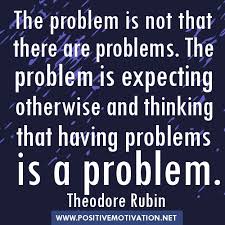
"The problem is not there are problems. The problem is expecting otherwise and thinking that having problems is a problem." Theodore Rubin

A problem is not a problem until you call it a problem. Before that, it is an occurrence or simply something that happened. Expecting all occurrences to be void of breakdowns/problems is a formula for disappointment.

From another perspective, think of the times you felt you were in the zone. It could have been an athletic event or a business transaction. When you were in the zone, problems had little or no effect on you. You may have looked at them as a slight bump in the road and you proceeded to solve the problem with little or no effort. And then you continued on with your goal.

Later, when you were asked how did you solve the challenge so effortlessly, you may have responded that it was like an outer body experience. And it would have been hard for you to explain. When we are in the zone, problems rarely show up as insurmountable. That's the example of when life is good. So why do people have problems with problems?

Perhaps the real reason we have problems with problems is because we secretly expect them. When they show up, we say, 'I knew something would go wrong'. It's like we programmed ourselves for the disappointment.

When they happen, we are upset because life seems to be filled with one problem after another. And all we want is a smooth harmonious life with no problems. It's like we are waiting for the day that we believe we deserve - a life with no problems. But, as usual, we know the next breakdown is just around the corner.

In fact, we spend time dreaming about the day we meet the right person and find the right job that will give us eternal peace and harmony. While at the same time, our environment has trained us to never get too happy because the next problem is around the corner.

Nevertheless, we have all had the experience of being in the zone. If you focus on doing something well, you will find it much easier to get into the zone. In that space, you will find problems rarely seem to be a problem.


Tuesday, 2 May 2017

The Procrastination Cure You Can't Put Off Any Longer


There are certain bad habits that get all the attention. Look around, and you'll see many warnings against smoking, overeating, binge watching TV, or drinking to excess. But there is one particularly nasty tendency millions of us share that doesn't get a fraction of the attention it deserves - the habit of procrastinating on our most important tasks.

It's easy to put off until tomorrow what we need to finish today. Unfortunately, that tends to leave you farther and farther behind on your work, and paints you as either inconsiderate of other people's time, or unable to manage your own life.

Study the people who have the most success in this world, and you'll find that they inevitably tend to be very punctual. They finish their work ahead of time, and never put off important tasks. And when it comes to being where they're supposed to be, they know that keeping to routines and schedules is important for maintaining control over their time, and will go out of their way to stick to their plans.

That's a big contrast to the way most people manage their schedules, of course, but it doesn't have to be. Here are three steps you can take today to break your procrastination habit...

Step #1: Recognize the Psychological Causes of Procrastination

Psychologically speaking, there are a lot of reasons people procrastinate. But a few stand out as being the most prominent.

First, it's easier for your subconscious mind to relax than it is to actively chase your conscious goals. Staying still or goofing off feels pleasurable and rewarding right now, whereas putting yourself through the mental effort of an uncomfortable activity doesn't provide an instant payoff. So certain parts of your brain are always going to want to pull you back to bed, onto the couch, or over to Facebook if you don't have good habits.

Another reason people tend to procrastinate so much is that they simply aren't motivated by the goals in front of them. When you aren't personally excited to achieve something, your subconscious will stop you from acting upon it. Your rational brain may know that your boss wants that report by the end of the day, but it doesn't feel urgent to you, which means it will take a lot of willpower to get moving.

And finally, people with low self-esteem tend to be the biggest procrastinators of all. They may feel afraid of success, or as if they don't deserve it. And so they self-sabotage their own efforts by putting things off until the last minute, missing deadlines, and making it impossible to do their best work.

Step #2: Face the Problem Head On

Regardless of which of these issues stops you from showing up on time or handling important tasks when you should, the best way to beat procrastination is to tackle the problem head-on with a few clear strategies.

The first is to simply make it harder to put things off. A classic example of this would be the person who puts their alarm clock in another room. In order to turn it off, they have to get out of bed, walk somewhere else, and press a button. By that time, they are far less inclined to hit the snooze button and do it all over again. That's a simple illustration, but there are probably dozens of ways you can remove distractions in your life and get things done faster.

You could also let others know that you're trying to beat the procrastination habit. Encourage them to acknowledge it when you're late, or make a pact with them that you'll set aside a few dollars every time you miss a deadline or put something off. That kind of simple punishment is enough to create a sense of accountability and get you thinking about your habits.

Step #3: Let the New Habit Take Hold

Don't expect you'll make the decision to stop procrastinating and be able to change your behavior in an instant. As with all habits, procrastination is something that is deeply ingrained at a personal and emotional level. You may have a few slip-ups, but if you are willing to acknowledge the problem and take steps to fix it, rest assured that you'll adjust over time.

Procrastination harms your productivity, your self-esteem, and your standing with others. But once you get in the habit of being proactive, showing up on time, and refusing to put things off when you could finish them right away, you'll start to feel more effective and empowered. Then the thought of not getting things done will start to feel strange to you.

You might be the kind of person who has put things off until the last minute your whole life, constantly running late from one task, meeting, or appointment to the next. Now is the perfect time to make a change. Don't put this improvement off until later - you'll be amazed at how much better you'll feel, and how much more seriously others will take you once you become the kind of person who doesn't procrastinate.


Monday, 1 May 2017

Improving The Quality Of Your Life One Step At A Time


Feel like your life is bankrupt sometimes? Knowing how to improve the quality of your life can't be left for chance or vague notions.

Knowing how others have improved the quality of their lifestyles is what you need. Here are 7 keys to guarantee the quality and substance of your life will get better:

1. You can't deny that all of your life hinges upon the quality of your health. Without good health, you can't maintain the lifestyle you desire, and good health doesn't stay by accident. Paying attention to your health is the starting place for improvement.

2. The way you handle finances has a direct bearing on the condition of every part of your life. Irresponsibility to money causes untold stress in every part of life. Personal money management is a must when it comes to improving your life.

3. The condition of your life is reflected by the friends you keep. You are the people you surround yourself with. Are your friends exemplifying the quality of life you desire? Chose friends wisely for the best life possible.

4. Gratitude is the unsung hero of all great people living dynamic and enhanced lives. Gratitude includes a thank you, but goes much deeper. Thankfulness for what you have is an attitude that when practiced brings life beyond your wildest expectations.

5. Simplicity is the opposite of confusion and drama. Make your life as simple as possible by deleting everything in it that you don't truly love. Take a look around your home, and decide what you truly need, and use. Discard everything else so that your life has room to expand and improve.

6. Give, give, give. Don't be tricked into thinking that giving what you have no use for will expand the quality of your life. To watch the quality of your life explode start looking around for someone in need of what you have already. Give your money, your possessions, and your time. When you give what you use and need it will come back many times over.

7. Last and not least is a plan to learn how to improve the quality of your life. Set aside an hour each week to do nothing more than think and read about methods for making your life better. This will make you conscious of what needs changing and how to change.

Getting the most out of anything always requires giving all you have, and life is no different. Make your life a long and rewarding adventure when you live it with a conscious intention to make it great.


Plus - You Can Now Join Our FREE Mastering Success Facebook Community at www.masteringsuccess.group


Thursday, 20 April 2017

4 Steps to Help You Be Heard When You Lack Self Esteem


You whisper a suggestion, and the person besides you parrots what you've said to great applause. You want to scream out and say "that was my idea" but your throat is dry, you feel clammy and sweaty and just want the moment to end. Your heart is beating so fast you are sure it is noticeable. At least the focus is off you for now but then suddenly it's your turn to offer something, to say anything and you can't. You are frozen in fear. Business moves on and you want to say something, to say anything so your superiors know that you have something to contribute. The stress response has three options for you, fight or flight, which we are familiar with and then the third, freeze. You cannot move. It's as though you have become disconnected from your body.

You are sick and tired of seeing those less qualified promoted above you, people you've even trained! Why doesn't anyone just notice you and sing your praises? You do all the work and do it well but it goes unnoticed. You've fallen into the rut of being dependable, you never say no to extra work but when favors are being dished out, no one notices your existence.

Was it always like this you ask yourself? You used to have ambition and drive but you're stuck. Your bosses are becoming younger and younger and see you more as a relic from a time gone by, no longer interested in the detail that you pride yourself on.

You find yourself feeling unwell, you may have IBS or other stomach related anxiety. Every day is nerve wrenching as you try to find a way to be noticed for the right reasons. You are competent when left to work alone but as soon as someone in authority is around, you freeze, just like what used to happen at school.

Why?

Because your mind associates authority and your "superiors" as somehow having power over you and you become the "little girl". This is who is reacting in any situation where the focus is upon you. You want attention but you don't and your mind becomes conflicted. You feel unworthy of attention as that inner critic seeks to silence you. How many times have you told yourself, no one is interested in what I have to say, what would I know, they'll laugh at me.

Communication has very little to do with the words that are spoken. It is tone and your body language. This is why bullying claims are very hard to prove, the words of he said/she said are anemic on paper.

Whispering won't get you noticed, you have to learn to speak up in such a way that others listen. They hear you. But you have to believe in yourself before others and believe in you.

Who is someone that is always heard? Do they whisper and cower or do they take up the space they occupy without any hesitancy or apology for being around?

You can use them as a model, a way to understand the relationship between confidence and body language. Improve one, you improve the other. Let's start with these 4 steps. Stand in front of your mirror to notice like a before and after image. Look at how you are standing and your expression, not fun for you, I bet. Now step away and do the following:

4 steps to learn how to speak up:

1. Lower your voice. That's right, lower your pitch. Little girls are high-pitched and so are women and men who lack confidence. Practice it in a store buying a coffee, practice at home.
2. Play your favorite tune in your mind. This must be a song from when you felt alive and confident, an anthem from your teenage years. Singing activates both parts of the brain, the left (logic) for the words and right for the melody. It immediately relaxes the body to prevent your shoulders rolling forward to try to disappear. Singing will encourage you to open your chest.
3. Learn to say "no". Whether or not, you have the time and energy, just start saying no. Don't add an excuse. Just say no. Practice this in the mirror, in a lower timbre and loosen the body with your favorite song, and say, no. Picture the person who prevails upon you the most, the person you carry and say no. Have a giggle to yourself at the sense of power this gives you. You are not a little girl/boy but an adult.
4. Whose confidence do you admire? It can be someone you know, or an actor or a character from a story or movie. See them in your mind's eye, what is it you admire? Drift into their bodies, like trying on clothes, and see what it feels like.

Now go back to your mirror, what are the differences you can see, I bet your face is more relaxed and your body more at ease!

These are little steps that you can adapt and use immediately. It is important to clear the past and choose a therapy modal that suits you. Hypnotherapy and NLP are ideal modalities to raise self esteem as they go to the core of your inner self, your subconscious mind and to heal your inner child self who never learned to speak up because she/he thought what they had to say was not worthy of being heard.

You don't need to be defined by your past. Let these 4 steps act as a catalyst to help you be heard.


Plus-You Can Now Join Our FREE Mastering Success Facebook Community at www.masteringsuccess.group


Source

Saturday, 1 April 2017

Don't Be Shy - Boost Your Confidence Before Giving Your Presentation


Have you ever been in a situation where you've given a speech, a presentation or a meeting update and it hasn't flowed as well as you would have liked? You're hesitant the next time you're about to present? If you're feeling uncertain about an up and coming event (such as a meeting, speech or presentation) check out these 10 pre-event confidence-boosting questions and see if answering them makes the difference:

1. Are you certain of your core message, point or outcome? If not establish what this is from the outset and allow everything else to flow from it

2. Have you prepared well enough for the event? If not what else can you do to prepare?

3. Does what you're doing make sense to you? Does it sit well with your values and principles? Just how important is it to you? How can you raise its importance in your mind?

4. What is your relationship with the people around you? Are there any issues here? How will this impact on your delivery? How can you modify your thoughts, feelings and behaviour to address the issues?

5. How can you ensure you express yourself clearly and well? (If you're certain of your core message and you're well prepared it should be much easier to state your case clearly and with conviction). Can you draw on a similar situation when things went well? What is the difference between how you felt then and how you feel now? Why is this?

6. What kind of material do you have? Is it clear and simple to understand for the visual, audio and kinaesthetic among your audience? Can you improve, simplify or clarify it?

7. Have you anticipated any tricky questions that may come up, and prepared responses to them?

8. What are you saying and thinking to yourself about the event? If you're telling yourself how badly it's going to go that's exactly what you risk manifesting

9. Have you looked at the situation from the vantage point of each person who will be at that event? What questions or issues arise when you do this? Can you deal with any of them in advance? If so how?

10. What other messages are being communicated to you from this uncertainty? What do you need to do to quell them?

Answering these questions should go some way to increasing your confidence and ensuring you are well prepared for your event.

Plus-You Can Now Join Our FREE Mastering Success Facebook Community at www.masteringsuccess.group


Saturday, 4 March 2017

How to Live a Happy Life: 10 Things to Say Yes to Starting Today

“Very little is needed to make a happy life; it is all within yourself, in your way of thinking.”
Marcus Aurelius
“Most people are about as happy as they make up their minds to be.”
Abraham Lincoln
“If you want happiness for an hour — take a nap.
If you want happiness for a day — go fishing.
If you want happiness for a year — inherit a fortune.
If you want happiness for a lifetime — help someone else.”
Chinese Proverb


Saying no is often the easier way out.
When you say no you can safely stay within your comfort zone. You don’t have to fear failing or being rejected. The scary unknown and sometimes difficult change can be avoided.
But if you say yes your life can expand and deepen. The yes allows you to open up your life to more happiness.
Today I would like to share 10 things that I have said yes to and that have helped me to become happier in my life.
Pick one of these that resonate the most with you and focus on making it a part of your life.
1. Being imperfect.
Trying to be perfect is setting the bar too high. It will be impossible to reach. And so you’ll lower your self-esteem. You may not feel very happy about how things are going in your life. Even though they might be going very well indeed.
Perfectionism is mindset that eats at you and your happiness. Saying yes to being imperfect can turn that around.
How to do it:
  • Realize the costs of buying into myths of perfection. By watching too many movies, listening to too many songs and just taking in what the world is telling you it is very easy to be lulled into dreams of perfection. It sounds so good and wonderful and you want it.
    But in real life it clashes with reality and it can harm or possibly lead you to end relationships, jobs, projects etc. just because your expectations are out of this world. I find it very helpful to remind myself of this simple fact.
  • Go for good enough. Aiming for perfection usually winds up in a project or something else very slowly or never being finished. So go for good enough instead. Don’t use it as an excuse to slack off. But simply realize that there is something called good enough and when you are there then you are finished with whatever you are doing.
2. Being you.
Not being able to be yourself, always trying to change for others or censoring yourself don’t feel good at all. It makes life feel so small and limited.
So how can you be yourself? Your environment plays a huge part.
How to do it:
  • Supportive people. Spend more time with the people who support your dreams, values and you. Or are at least neutral. And spend less time with people who always criticize you or you simply aren’t a good fit for.
  • Supportive and life-expanding influences outside of your everyday life. Change your environment not only close to you. Go further and spend more time with sources of information that supports your dreams and can give you information that expands and makes your life happier and more exciting. Find support from people you have never met via books, movies, blogs, forums and music. And spend less time with negative and limiting influences.
3. The things that make you come alive.
It is important to find some time and energy for the things that you feel makes you come alive.
How to do it:
  • Mix it up. Try something new, even if it is just something small each week. Eat the vegetarian dish at lunch if you always eat meat. Listen to some music that isn’t your normal cup of tea. Go out to a movie, café or pub with friends if you usually stay in at night. Or vice versa. Create variation and expand your comfort zone regularly in small ways to live a happier life.
  • Reconnect with what you used to love if it has fallen by the wayside. If you used to go fishing, paint or play the guitar and it really made you come alive then reconnect. Use an hour for it this week and see if it still brings you joy and makes you come alive.
4. Optimism.
Pessimism can really limit your life and bring it to a standstill. It can make it feel like there’s no point in trying because it won’t make a difference or you’ll just fail. It can create ceilings and walls made out of glass where there really are none.
Saying yes a more optimistic way of thinking can on the other hand open your life up.
How to do it:
  • Ask yourself optimistic questions. When you’re in what seems like a negative situation then make something better out of it by asking yourself questions that promote optimism and helps you to find solutions. Questions like: What is one thing that is positive or good about this situation? And what is the opportunity within this situation?
  • Start your day off on the right foot. As mentioned in tip #2, the influences in your life can make a huge difference. So choose to spend your breakfast time with an optimistic influence like for example a book, a blog or your mom. Or talk to someone early in the day that most often supports and cheers you up like a co-worker or a friend in school.
5. Turning negative self-talk around.
It is very important to keep your motivation and your self-esteem up to live a happier life.
Your inner critic may be one of biggest obstacles standing in your way of that. If you make a mistake or fail, if someone criticizes you or if you are just getting tired then that small inner voice can become louder and louder and drag and keep you down.
It can tell you that you are stupid or lazy. That you will not succeed. That you are worse or uglier than someone else.
Being able to turn the inner critic around or to shut it up as soon as it pops up is a very helpful skill.
How to do it:
  • Say stop. Simply create a stop word or stop-phrase that you say or shout in your mind whenever your critic pipes up with a distorted and self-esteem hurting thought. Say: Stop! Or: No, no, no, we are not going there again!
  • Explain to yourself what this will lead to over the next year or more. As I mentioned in tip #1, reminding yourself of the cost of buying into myths of perfection is a powerful way to replace those thought habits. This works very well for other self-esteem hurting thought patterns too. Remind yourself of how the inner critic has shaped your life so far. And in your mind see the cost of letting it roam free for another year or five.
6. Saying no when you feel it is the right thing for you to do.
To have the time and energy to say yes to the most important things you have to say no to some things too.
How to do it:
  • What do I truly want to focus my time and energy on? When you get an offer or an opportunity arises ask yourself this question. When you look over your schedule ask yourself this question. Think about and look at what your top priorities are and what you deep want before you say anything.
  • Disarm and then state your need. It becomes easier for people to accept your no if you disarm them first. You could for example do that by honestly saying that you are flattered or that you appreciate the kind offer. Then you, for instance, add that you do not have the time for accepting and doing what they want. Or say that you do not feel that this offer is a good fit for your life right now.
7. Forgiveness.
Not clinging to the past and to the hurt that is there but to let it go and look to the now and the future is an essential thing to find more happiness in your life.
Forgiving is not always easy and can take time but there are some things that can make it a little easier.
How to do it:
  • Remind yourself that you forgive for your own benefit. As long as you don’t forgive someone you are linked to that person. Your thoughts will return to the person who wronged you and what he or she did over and over again.
    The emotional link between the two of you is so strong and inflicts much suffering in you and – as a result of your inner turmoil – most often in other people around you too. When you forgive you do not only release the other person. You set yourself free from all of that agony too.
  • Make a habit of forgiving yourself. Do not just forgive others but also yourself. By forgiving yourself – instead of resenting yourself for something you did a week or 10 years ago – you make the habit of forgiveness more and more of a natural part of you. And so forgiving others becomes easier too.
8. Making someone else happy.
Making someone else happier has many benefits. The happiness spreads back to you as you see his or her face light up and as you know you did the right thing.
It spreads back to you as people have a strong tendency to want to give back when you have done something good for them. And it spreads out into the world as that now happier person may spread his or her happiness to other people.
How to do it:
  • Help out practically. Lend someone a hand when they are moving. Or give them a ride in your car. Or if they need information, try to find a solution by asking the people you know or via Google.
  • Just listen. Sometime a friend or someone close to you may just want to vent or for someone to listen as he or she figures things out. It may not seem like much but it can be an immense help for someone who needs it. So be there fully – don’t sit there thinking about something else – and listen.
9. Openness and growth.
Saying yes to being open to the good things in life and growing as a person plays a big role when it comes to happiness.
The other things in this article will help you with that. But here are two more tips that will make your journey a little easier and simpler.
How to do it:
  • Change one thing at a time. Changing many things or your whole life at once sure sounds good. But willpower is something we often overestimate and everyday life tends to come in the way. So to make sure you have a much better chance of changing a habit or area of your life change just one thing at a time.
  • Start small. Just say no to one small thing you don’t want to do this week. Or forgive one person for one thing. Or help and make someone happy in some small way. Take just one small step outside of your comfort zone.
10. To living your life fully despite setbacks.
When things have been standing still for while or you hit a bump in the road then it’s easy to back down. To shrink. To give in or give up.
But a better way to say yes to happiness in those situations is to say yes to living your life fully.
How to do it:
  • Keep going. When you fail or make a mistake don’t give up. Reconnect with optimism by using the questions further up in this article. Find inspiration from books and blogs and the people around you. Don’t beat yourself up. Instead nudge yourself back on track again.
  • Remember, it’s not too late to change your life. I didn’t really try to improve my life very much until I was 25. And many throughout the world and history have made positive changes far later in life than that. So if you want to make a change then start today. Work with what you have where you are right now. Start small and take the first step towards something new.
Plus-You Can Now Join Our FREE Mastering Success Facebook Community at www.masteringsuccess.group

Thursday, 16 February 2017

How to Start Getting Better Sleep & Adjust Your Patterns


It is easy to think that in order to be successful, we should limit the overall amount of time we spend lying down in bed. After all, that time sleeping could instead be used to work a little bit more, right?

Well, it can, but there is also something to be said for more sleep equalling better productivity.

In the high-paced entrepreneurial world, it’s easy to get caught up in the culture of listening to others bragging about how little they sleep, which in turn may make you feel like you need to do the same.

However, “slow and steady wins the race” is a proverb you should connect with, as those who pace themselves can avoid being burnt out later on.

Sure, there is no denying that some successful people thrive on unusual sleeping patterns, but what works for them may not necessarily work for you.

If you’re utterly exhausted each day but convinced that less sleep means you can do more work, then you’re only fooling yourself. Ultimately it can be counterproductive to sleep fewer hours simply to keep up with the Joneses, so to speak.


How to Start Getting Better Sleep

Along with the knowledge that you are preventing fatigue later down the line, there are many great reasons why more sleep can help boost your body and mind, including becoming less distracted, making better decisions over the day, improved memory, and fewer mistakes.

Furthermore, more sleep will make you far less likely to reach for coffee or energy drinks simply to keep you focused. And don’t even think that you can simply “catch up” on sleep over the weekend after a busy week, as this method won’t work at all

Human beings need a regular sleeping pattern.

So, if you’re a busy person but have always felt that you never have the time to get a decent amount of quality sleep, then consider the following points:


1. Incorporate it into your schedule

Although it might seem odd to write “go to sleep” into your diary as part of your schedule, marking out a point in a 24-hour day when you can lie down and forget your worries is hugely important.

Of course, many people work on different timetables over the day, so stating that 11 pm should be your bedtime isn’t realistic for everyone.

However, planning out your day so you can make time for at 6-8 hours of sleep is a good habit to start. Is 2 am to 10 am the only viable option?

That’s fine, but as long as that’s a schedule you can stick to, then do it.

2. Have the best sleep that you can possibly get

It might be tempting to leave your phone on when you sleep “in case of business emergencies,” but if people are aware that they can contact you 24/7, then how can you ever truly relax?

Your mind needs to be in a state of rest at some point of the day, so try to make it a rule that when you sleep, your phone does as well.

This goes for checking emails and all manner of work communication before bed too, as this should be unwinding time, and any work news isn’t likely to make you unwind!

In general, your sleeping environment should be as close to perfect as you can get.

A memory foam mattress is often considered a great option to ensure a comfortable sleep, but make sure to read the pros and cons so you can make up your own mind before committing.

As for other sleep accessories, eye masks and white noise machines are also worthwhile to help getting the best sleep possible. This is your time to focus on anything but work, so switch off that part of your brain and simply relax.


3. Tactical naps


This is really a day-by-day scenario, but when there are a spare 20 minutes over the course of your work time, then by all means, take a 10 to 20-minute nap.

Any longer can kick your brain into a deep REM sleep, which may make you feel groggy when you wake up.

Short naps have long been associated with improved cognitive functions, so if you feel your eyes start to droop and concentration slipping, there is every reason to power down for at least 20 minutes.

Some major companies even urge their employees to take a quick nap over the working day, including Google, Zappos, Uber, and Ben & Jerry’s.

Mary Gresham, a clinical psychologist in Atlanta, says:


“MORE AND MORE, WE ARE RECOGNIZING THE IMPORTANCE OF SLEEP AS A MECHANISM OF CONSOLIDATING INFORMATION, DEALING WITH THE EVENTS OF THE DAY, AND RECHARGING OUR ENERGY.”

Stefan Camenzind, CEO of Evolution Design, also adds:


“MOST PEOPLE ARE TOLD THAT THE HARDER YOU WORK, THE LONGER YOU WORK, THE BETTER IT IS. THAT’S NOT SUSTAINABLE, AND THAT’S PROBABLY ALSO NOT TRUE. IT’S ABOUT SMART WORKING, AND THAT MEANS YOU NEED TO RECHARGE. IN THIS CONTEXT, NAP ROOMS BECOME MORE AND MORE IMPORTANT.”


Final thoughts


In the end, being successful is something that is built over time.

But although many entrepreneurs will make the point that hard work and dedication are the tools for accomplishment, they are not the only means.

Along with the many great ways to reduce stress, good sleep lets us remain focused on the tasks ahead and allows us to unwind.

“Sleep on it” is yet another proverb that you’ll be familiar, but it certainly holds true, as often that “Eureka” moment first thing in the morning.

Work is important, no doubt, but it isn’t our whole life.

Do you really want to sacrifice your social and family life simply to tell others how hard you’re working?

Think about the long-term. So, if you are feeling beyond tired and believe that you need to work longer in order to keep up with your competitors, think again. Take the time to genuinely rest your body and mind and you will be far better off in the future.
Are you getting better sleep after reading this article? Leave a comment below
hare

Monday, 30 January 2017

4 Steps to Rebuilding Your Motivation

How do you defeat the self-inflicted agony that each one of us as humans have felt at some point or another? How do you work through the pain that hurts so much to the point that we don’t want to deal with it anymore? How do you not give up?


Here’s how:

Step 1—Understand that you’re not alone and the feeling isn’t permanent.

The first step towards crawling back to taking control of your life when you’re on the verge of giving up is really just remembering that you’re not the only person who has felt hopeless, all of us understand what you’re feeling and where you’re coming from. We’ve all been there, and chances are that we’ll each be there again, so it really is kind of about understanding that it happens to everyone, and even more importantly, these moods and feelings come and go in waves. Just because you feel down and without motivation right now doesn’t mean it’ll last forever. It may be gone tomorrow, it may be gone a week from now or a month from now, but it is temporary.

Step 2—Start believing in yourself.
You have the power to let go of negative beliefs about yourself. You also have the power to create positive beliefs that will empower you rather than hinder you. The point of feeling like you want to give up comes from becoming the victim of the negativity of your own internal dialogue. You want to give up because the conversation that takes place in your head tells you you aren’t good enough, you’re not competent, you don’t have it in you, and that maybe what you’re doing isn’t worth the reward you’re expecting. These are problems that we all face as humans on a daily basis simply because our minds are neurotic; they’re negative, and we believe them.

In order to start believing in yourself, you have to stop believing what your mind says. Stop believing the negativity that plays out in your mind and start to laugh at it. You have the power to let go of negative beliefs, and at the same time create positive beliefs that are self-empowering.

Step 3—Start changing your life in ways that will reflect a change in your attitude.

You are the things that you do on a daily basis. If you want your life to change, if you want your moods to change, if your attitude to get better or your motivation to be higher, you have to begin changing your daily actions in a way that will exhibit change in your life.

For me, the way I stay motivated when I’m feeling down is by starting to do daily habits that are difficult, that challenge me and help me grow my willpower. Not only do you feel accomplished when you take on challenging habits, but you are literally strengthening your willpower.

It really is about keeping your energy levels high, and challenging yourself with difficult habits. Developing these habits will help you deal with the negativity that drains you physically, mentally and emotionally.
What are these habits?

Waking up early helps me take time to enjoy my life, and focus on the actions I know are necessary to accomplish my goals. When you become a morning person, you begin to feel empowered, accomplished, and you create time for yourself while the rest of the world is still asleep and there are no distractions.

Meditating is a very important habit that really will help you understand the negative thoughts you have. It will help you begin to separate from those thoughts with the understanding that you are not your thoughts. When you believe your negative thoughts and identify with them, you have no power, you feel horrible about yourself and you will lack motivation. Start to understand your own negativity by meditating for just a few minutes a day and you will find that your motivation levels rise instantly.

Reading is another integral habit that helps keep me motivated. I read about people who have been successful in life; people who seemingly have infinite motivation within them to do everything they set out to do. There’s nothing more motivating than learning from successful individuals who have detailed accounts about what kept them going and how they were able to stay strong in difficult times. You and I are no different and we can take lessons from successful, motivated people and implement those strategies in our own lives.

Step 4—Surround yourself with people who exhibit qualities that you want to possess.


The most important thing you need to do in order to keep yourself motivated and positive is surround yourself with people who you want to be like rather than surrounding yourself with people who are just like you. We become the people we hang out with, and I like to say that we’re an average of the 5 people we spend the most time with. If you surround yourself with people that are just like you, you will never change. But if you begin to surround yourself with motivated, positive people that are go-getters, you too will become a positive person with proper motivation who is a go getter.
Conclusion

Don’t give up. When you’re about to give up is the point where its most important to show up with strength and not give into the difficulty you’re facing. Just remember, this is temporary, you’re not alone, change is possible, and you have the strength in you to live the life you want.

Monday, 23 January 2017

A Guide to Motivation


Motivation and drive are the most elusive of things.

Those who naturally possess these traits are able to get ahead and cannot comprehend that others do not automatically have the need to be active and productive.

For most of us, it is something that we can learn.

Motivation is something I struggled with for many years. Procrastination was the rule. "Why do it now?" "I can do that tomorrow." Then the time passes and it turns into "it's too late to do that now".

I thought that this was the only way I'd ever be, despaired at the thought that I'd never achieve what I thought I could and I always fell back into the same pattern of "doing something about it later."

I've taught myself motivation and given myself that drive that was missing for so long. The most important thing I've learnt? It's easier than you think.

The first thing to learn is how to be productive. I came across a phrase that helped me rationalise where to start.

"Never have a zero day"

The essence of this is not allowing yourself a day where nothing is achieved. You can set the goals as small as you need to start with, do some washing up, tidy your room or file some paperwork. As long as you've done something that you can count as productive then you've avoided a zero day. You'll soon find that you're doing the small stuff automatically every day and the goals you set will become bigger. This is a great way to start your path to productivity and avoids the urge to crash out in front of the TV as soon as you finish work.

Once you've started to deal with the small stuff then you can think about taking on bigger challenges. Whatever it is that you've been avoiding starting is the next objective. The hardest part about larger challenges is that the end goal seems too remote and far away. Without the focus of immediate benefit it can be difficult to get the right mindset to even start a longer project. So how do you visualise the outcome? The short answer is that you don't. Not to start with.

I'll share a metaphor that my mother used when I was growing up, unfortunately it took me years to realise the significance!

You have a whole house to tidy. The mess in each room is overwhelming. How do you know where to start? What's the best order to do it in? Should I clean the kitchen or the living room first? It doesn't matter. You have to pick something up and put it in the right place. Again and again. Do this enough and the whole house will be tidy.

Break down the issue in to the smallest increments possible and start by completing them. The objective is not to finish the project but to start it, to be making progress towards it. This is the important part. Making progress is just as important as the end result.

This leads nicely on to the next point. I'm going to use a quote from Commander Chris Hadfield who can sum it up better than I can, and with much more authority.

"Every decision you make, from what you eat to what you do with your time tonight, turns you into who you are tomorrow, and the day after that. Look at who you want to be, and start sculpting yourself into that person."

Set yourself long term goals but don't sweat about reaching them too quickly. The important thing is putting yourself on the right path. Make good decisions about the little things and the big things will happen for you. As long as you're making progress along the path to your goal then you're doing the right think and making progress is an achievement!

Now you're on your journey to productivity, but can you stay on it?

Look back at your progress regularly. You don't need to analyse in detail every action on every day but now is the time to look at the bigger picture. Consider your position a month ago, a year ago. Has it improved? Then imagine how it will be in the future. Use this to push yourself further.

The final advise is one that I've found particularly useful recently. Give yourself productive hobbies where you are achieving goals and keep them diverse. Learn a new skill or work on existing skills, pick up a new language or a musical instrument. By being able to change what you're working on you can keep everything fresh and interesting.

It is important to realise that this isn't giving up. You can come back with a fresh outlook and more enthusiasm than you left it. But remember to never leave one thing too long or what you're working towards can disappear.

The key things to take away?

No Zero Days

Start small

Have long term goals

Review your progress

Keep it interesting!

Following this will mean that suddenly your downtime is spent improving your life rather than watching it pass by.


Sunday, 15 January 2017

The Power of Habit


Aristotle once said, "we are what we repeatedly do" and this shows the power of habit. If we are repeatedly doing things that lead to greater success, then we will be successful but if we are repeatedly doing things that hinder our success then we will not get what we want in life.

Create a Habits List

Before creating a to do list think about creating a 'habits list', this is a list of the habits you want to create and a tracker to help you track those habits. Let's say for example that it is your goal to lose weight. In order to lose weight you need to exercise regularly and so onto your habit tracker you would put exercise and then each day that you exercise you would tick off that item on your habit tracker and know that you have taken a step closer to your goal. If you just had to exercise once though it wouldn't be much help so you need to make a habit of exercising at least three times a week.

How Long Does It Take to Form a Habit?

Some people say 21 days, others say you should aim for three times that amount. Personally, I think it is better to aim for three times that amount because if you give yourself a break too early then you may find that the habit is easily broken and it is too easy to fall back into bad habits. By challenging yourself to practice this habit for longer you are ensuring that it becomes a part of your life and you are less likely to give it up as it becomes part of you.

Breaking Bad Habits

In addition to creating good habits, if you want to really achieve success then you also need to break bad habits that are hindering you from becoming all you can be. Let's go back to the weight loss example and say you have a habit of getting take-aways for dinner every night. If you want to lose weight then exercising in itself is not going to be enough, you need to learn to develop healthier eating habits and that means breaking the bad habit of getting take-aways all the time. Learn how to do meal preparation and plan healthy foods that will promote weight loss.

"We are what we repeatedly do" and so we need to create habits that are going to help us achieve success. It is not enough to simply do something once and hope it will bring you success, you need to do it repeatedly. Create habits that will help you become the person you want to be.


Saturday, 7 January 2017

The Power of Habit: 4 Steps to Creating Good Habits


People tend to think that habits are unbreakable. They feel it’s exceedingly difficult to change habits for the better. After all, that’s why so many people struggle to lose weight, quit smoking, or beat procrastination.

But, what if I told you that was wrong?

Habits can be changed. Not only that but changing a habit is easier than you think. What it does involve is thinking about them differently.

He uses a combination of research backed science and his experiences of habit change to take the reader through how to make changes in their lives.

In this post, you’re going to learn the four steps Duhigg has found that helps to get rid of good habits and create new ones.


How Habits Are Formed

We develop habits over time by creating a loop that we repeat over and over again. It’s that loop that cements habits in our minds.

There’s a three-step process that goes into every habit you form:
Cue
Routine
Reward

In basic terms, here’s how it works:

A habit is formed when a cue signals a routine that provides the brain with a reward.
When that feedback loop is created, your brain shuts off when it comes to making decisions about that loop.

This is why it’s so common for a smoker to automatically have a cigarette after their morning coffee. They’ve done that action so many times it’s cemented itself as a loop in their brain. More often than not, they light up without even thinking.

It’s also why these seemingly routine tasks are so difficult to break. When smokers are trying to quit will talk about how the hardest time to avoid smoking is during that morning coffee. It’s because when that cigarette is removed the loop is broken, and the reward is gone.

Understanding that loop is the key to success with any habit is replacing a “bad”habit with a “good” one. You do that by replacing the reward portion of the loop.


(We’ll cover each of these steps a little bit more in depth later on, so keep reading!)

The secret to success is finding a “good” reward that replaces the craving.

In this case, maybe the coffee is the reward, not the cigarette. So it could be possible that by keeping the coffee and removing the cigarette the reward is still there, thus making it a lot easier to stop smoking with that morning coffee.


Creating “Good” Habits

One way you can look at this is through creating Keystone Habits. These are like good habit dominos when you have one good keystone habit; others begin to fall in line.

Losing weight is a common place where creating a keystone habit can make a massive difference with success. We all know it can be difficult to lose weight, many people struggle with it.

What Duhigg found, however, was that researchers began to see one keystone habit that helped people to lose weight over and over again. It wasn’t exercise or drinking more water; it was keeping a food journal.

Seems simple, right? But in reality, this practice is a fantastic example of a keystone in action.

The food journal let dieters keep track of exactly what they ate. Because of this, they were able to identify foods that were bad, see if they fell into common traps, and make small dietary changes.

All of these ‘small wins’ can dramatically add up to significant weight loss over time and reinforce a positive habit loop.

Alright, so now you’re probably wondering how you can start accomplishing some of those New Year’s Resolutions and finally create good habits that stick.


How to Change a Habit (in Four Easy Steps)

Through all of his research and personal experiences in the book, Duhigg found there is a four step framework to replace a “bad” habit with a “good one.”

We’re going to look at each of the steps in the framework below.

Step 1: Identify The Routine

We know every habit has three main parts: the cue, routine, and reward. Here, the first step is to think about the habit you want to change.

Once you’ve identified a specific habit, the next thing you need to do is walk through the routine associated with that habit. So you want to think about the “the reward driving your behavior, the cue triggering it, and the routine itself.”

If you’re a smoker, think about what you do every time you light up. If you have a killer sweet tooth, try to note what is happening when you go for that cookie after dinner. And, If you consistently give up when trying, new things look at the routine around how you’re setting yourself up for success.

Duhigg found he was gaining weight because every day he went to the cafeteria at the New York Times (where he’s a writer), would buy a cookie, and eat it while chatting with friends.

This habit was the routine. It’s going to be the action you take around something.
Remember, when habit loops form, the brain just goes through the motions. What you need to do is start training your brain to think again. To change that routine, you need to get your brain kickstarted again and involved in the feedback loop.


Step 2: Experiment With Rewards

When it comes to bad habits, the reason why you stick with them is that of the reward. If your body and brain get something out of a habit, then the brain is going to keep doing it.

More often than not, it’s this reward that is the entire reason why you’re stuck in a bad habit loop. The reward is what is the response to the craving; the reward satisfies it.

What you need to do is see if you can find a new reward that will still give your craving the same satisfaction but removes the negative action.

Here’s where you are going to have to do a little bit of scientific (well not so scientific) testing. Try experimenting with different rewards.

So, the next time you’re craving a smoke with your morning coffee, try a few other routines and see if anything works. Here are a few ideas:
Have a glass of water
Chat with a friend or coworker
Do squats for 30 seconds
Look at a picture of your pet


Do that for a few days or a few weeks until you can start seeing some patterns. And right after you try each new routine, Duhigg advises you do two important things.
Write down the first three words that come to your mind
Wait 15 minutes to see if you are still feeling the craving

This makes it easier to track to see what’s working and what isn’t. If your new routine is making you miserable, note that. If you feel great 15 minutes after looking at a picture of your puppy, then you’ve begun the process of creating a replacement loop.


Step 3: Isolate The Cue
Every habit has a trigger and finding this is the key to changing your habits. Unfortunately, this is typically the hardest part.

The reason?

According to Duhigg, researchers have found that our brains are just constantly bombarded with too much information, too many inputs to quickly determine what the primary cue is.

Fortunately, there are ways to find the signal in all that noise. Duhigg talks about five major cues that almost every habit falls into:
Location
Time
Emotional State
Other People
Immediately preceding action

Here’s an example straight from the book that will help you understand. Duhigg found he had gotten into the bad habit of eating cookies every afternoon. He’d go to the cafe, buy a cookie (or two) and chat with coworkers.

He wanted to stop this habit and save his waistline, but it was hard to determine exactly what the cue was.

From the book:

So, if you’re trying to figure out the cue for the ‘going to the cafeteria and buying a chocolate chip cookie’ habit, you write down five things the moment the urge hits (these are my actual notes from when I was trying to diagnose my habit):
Where are you? (sitting at my desk)
What time is it? (3:36 pm)
What’s your emotional state? (bored)
Who else is around? (no one)
What action preceded the urge? (answered an email)

He wrote down what happened when he felt the urge for the cookie for a week and found one interesting tidbit.

Every time he wanted a cookie it was around 3:30 pm. This hour long period was the cue. To change this habit, he had to do something else to get a new reward.
This is where having a plan comes in.


Step 4: Have a Plan

Once Duhigg was able to identify the cue, he needed to come up with a plan to change it. Having a plan is the critical point here. After you’ve done the hard work of realizing what the cue is in the habit you want to change, you need to attack it with a specific plan.

Remember, because your habit is set in motion, it means your brain does it automatically. The point of the plan is to help re-wire this habit.

So, back to the example above.


After tracking his behavior and asking the questions he saw that the real ‘reward’ he got from going to the cafe wasn’t the cookie, it was able to chat with co-workers for a few minutes. He wanted to socialize.

Here is the plan he came up with:


“AT 3:30, EVERY DAY, I WILL WALK TO A FRIEND’S DESK AND TALK FOR 10 MINUTES.”


It didn’t go perfectly at first. The brain is tricky that way. Realize that forming a new habit loop is hard and prepare for the fact that you will fall off the wagon. That’s where the plan can help.

After a few weeks, Duhigg didn’t need an alarm or note to get himself up and chatting with a friend at 3:30 pm, he did it automatically. He was able to dramatically reduce his cookie buying, lost weight, made new friends, and felt much better.

His brain had re-wired a new habit.


Final Thoughts

As you go through the process of trying to change your habits, remember what Duhigg calls The Golden Rule of Habit Change:


“YOU CAN’T EXTINGUISH A BAD HABIT, YOU CAN ONLY CHANGE IT.”


Anything you want to change, you can. Just put the above steps into practice. It won’t always be easy, but once you start locking down those small wins, then the sky is the limit.